

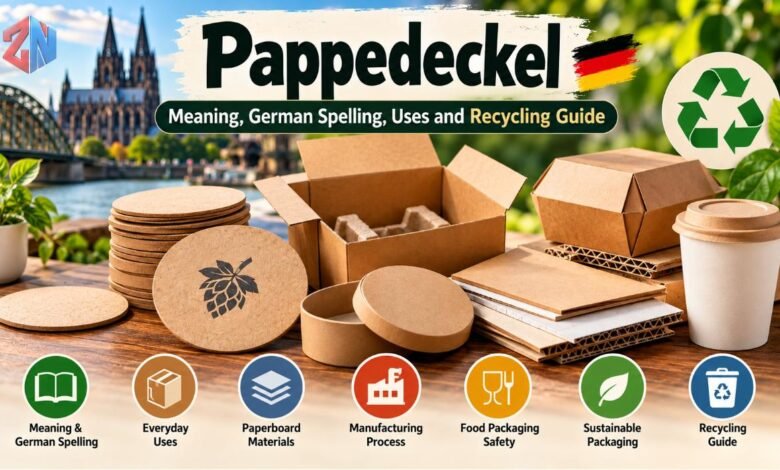
Pappedeckel is a regional German expression associated with cardboard or cartons. The related standard German forms Pappdeckel and Pappendeckel refer to a piece of cardboard. Depending on the context, cardboard materials may be used for a protective cover, a packaging component, or even a drink coaster.
Although the word looks straightforward, its meaning is not always captured by the literal translation “cardboard lid.” Regional German expressions and similar spellings can create confusion.
Understanding Pappedeckel is useful for anyone interested in German vocabulary, packaging materials, everyday household products, or environmentally responsible packaging. This guide explains its meaning, spelling, common applications, manufacturing methods, and recycling considerations.
What Does Pappedeckel Mean?
The meaning of Pappedeckel comes from its connection with two German words:
- Pappe: Cardboard, pasteboard, or stiff paper-based material.
- Deckel: A lid, cover, or top.
Together, these elements suggest a cardboard cover. However, established German dictionary definitions of the related forms are broader.
The German dictionary Duden defines Pappdeckel as a piece of cardboard and identifies Pappendeckel as a related form. Its examples also show that cardboard pieces may be used beneath drinks.
Therefore, the appropriate English translation depends on what someone is describing.
For instance, someone discussing packaging might be referring to a protective cardboard cover, while a person discussing crafts might simply mean a piece of stiff cardboard. These are possible applications rather than fixed dictionary definitions of Pappedeckel.
The term does not identify one particular product, size, or manufacturing standard.
Pappedeckel, Pappdeckel and Pappendeckel: Understanding the Difference
Several similar German spellings appear in conversations, online articles, and regional vocabulary.
Standard German Spellings
Pappdeckel and Pappendeckel are established dictionary forms. Both describe a piece of cardboard, and their meanings substantially overlap.
Pappedeckel is less typical in formal standard German. However, it should not automatically be dismissed as an invented word or typing error.
The spelling is documented in regional Alemannic vocabulary, where it is associated with cardboard or cartons. Some regional usage also connects related expressions with a driver’s licence.
Why Regional Differences Matter
German vocabulary varies between regions, especially in everyday speech.
A familiar expression in southwestern Germany may not be understood in exactly the same way elsewhere.
For formal writing, translation, or product descriptions, using a recognised standard term is usually clearer.
If the intended object is a packaging lid, Kartondeckel may communicate the function more precisely than a general cardboard-related word.
Pappedeckel vs Bierdeckel: Are They the Same?
Pappedeckel and Bierdeckel are related through cardboard materials, but they are not interchangeable in every situation.
| German Term | Typical English Meaning |
|---|---|
| Pappedeckel | Regional cardboard-related term |
| Pappdeckel | Piece of cardboard |
| Pappendeckel | Cardboard or cardboard piece |
| Bierdeckel | Beer mat or drink coaster |
| Kartondeckel | Cardboard box lid or cover |
A Bierdeckel is specifically a coaster placed beneath a drinking glass.
The Connection With German Drinking Culture
Cardboard drink coasters have a long history in German hospitality.
In 1880, Friedrich Horn’s company near Magdeburg began producing printed cardboard coasters. In 1892, Robert Sputh registered an invention involving absorbent wood-fibre beer coasters that supported industrial production.
Today, coasters help absorb moisture and protect tables. Their surfaces can also display brewery branding, artwork, or promotional messages.
However, a cardboard packaging insert is not automatically a Bierdeckel simply because both objects are made from similar materials.
What Materials Are Used in Pappedeckel Products?
Cardboard products are usually made from paper-based fibres, although their structure and performance vary.
Paperboard and Solid Board
Paperboard is generally thicker and more rigid than ordinary writing paper.
It is commonly used for lightweight packaging, presentation folders, product backing, and protective covers.
Solid board can provide additional stiffness where a thin sheet would bend too easily.
Corrugated Cardboard
Corrugated cardboard contains a fluted paper layer between flat liner sheets.
This construction improves cushioning and rigidity while keeping the material relatively lightweight.
It is particularly useful for shipping boxes, protective inserts, and packaging that needs extra structural support.
Coated and Uncoated Materials
Uncoated cardboard often absorbs moisture more easily. That characteristic can be desirable for drink coasters but unsuitable for certain food containers.
Coatings may improve resistance to water, grease, or wear.
However, coatings can also affect recycling and disposal options. The composition of the complete product matters more than its appearance alone.
Common Uses of Pappedeckel in Everyday Life
Cardboard pieces and covers serve several practical purposes.
Packaging and Product Protection
Paperboard components can protect products from scratches, separate items, or provide a stable backing.
For example, a manufacturer might use a cardboard insert to prevent small objects from moving inside a box.
A properly designed cover can also help protect a container’s contents during handling.
Crafts and Education
Stiff cardboard is useful for school models, decorative shapes, templates, handmade cards, and display boards.
It is easy to mark, cut, fold, or decorate with suitable tools.
For projects involving children, adults should choose age-appropriate materials and supervise the use of sharp cutting tools.
Hospitality and Advertising
Printed cardboard coasters are common in restaurants, cafés, and bars.
Businesses can use them for logos, promotional designs, or event information.
Their usefulness comes from combining a practical surface-protection function with space for printed communication.
Why Are Cardboard Products So Widely Used?
Paperboard remains useful because it offers a balance of practicality, affordability, and design flexibility.
It can be shaped into different sizes and forms without requiring complex construction for every application.
Its main advantages include relatively low weight, printability, easy customisation, and compatibility with many existing packaging systems.
Nevertheless, cardboard has limitations.
It may lose strength when wet, become damaged through repeated handling, or perform poorly under heavy loads.
A moisture-resistant coating can improve performance, but that change may also introduce additional material complexity.
Choosing the right design is therefore more important than assuming every cardboard product performs equally well.
How Are Cardboard and Paperboard Products Manufactured?
Manufacturing methods depend on the intended application.
Paperboard production generally begins with cellulose fibres obtained from suitable raw materials or recovered paper.
The fibres are processed with water to form pulp. The pulp is then formed into sheets, pressed, and dried.
For a finished cardboard component, manufacturers may cut, score, fold, print, laminate, or shape the board.
A simple flat insert needs fewer production steps than a precisely fitted food-container lid.
Some products also require specialised forming or coating processes.
The finished board’s thickness, fibre composition, surface treatment, and construction determine how it performs.
Are Pappedeckel Products Safe for Food Packaging?
Paper-based packaging is not automatically suitable for direct food contact.
Materials intended to touch food must be appropriate for their intended conditions, including temperature, moisture, and the type of food involved.
In the European Union, food-contact materials are covered by Regulation (EC) No 1935/2004 and applicable manufacturing requirements.
Germany’s Federal Institute for Risk Assessment (BfR) also publishes recommendations concerning paper and board used in food-contact applications.
For example, a decorative cardboard sheet should not be assumed suitable for direct contact with hot or greasy food.
Businesses purchasing packaging should request appropriate food-contact documentation from their suppliers.
This distinction is particularly important for takeaway containers, cups, bakery packaging, and food covers.
How to Choose the Right Cardboard Cover or Product
Before selecting a cardboard component, identify its intended function.
A protective insert, drink coaster, and takeaway lid have different performance requirements.
Consider the following factors:
- Thickness and strength: Will the board support or protect the intended object?
- Dimensions and fit: Does the component match the container or packaging?
- Moisture exposure: Will it encounter condensation, liquids, or grease?
- Food-contact requirements: Is it intended to touch food directly?
- Surface finish: Are printing, coating, or decorative treatments necessary?
- Disposal options: Can the finished product enter a local recycling stream?
For businesses ordering custom packaging, requesting samples is a practical way to assess fit and handling.
A product that looks attractive may still be unsuitable if it bends, leaks, or does not fit securely.
Is Pappedeckel Environmentally Friendly?
Paperboard products can offer environmental advantages in sustainable packaging, especially when they are responsibly sourced, efficiently designed, and successfully recycled.
However, cardboard is not automatically sustainable in every application.
Manufacturing requires raw materials, water, energy, and transportation. Additional coatings or mixed-material construction may complicate recovery.
The German Umweltbundesamt highlights both the resource benefits of recovered paper and the challenges caused by contaminants entering paper recycling streams.
A sensible environmental assessment should consider the product’s entire life cycle rather than its material name alone.
Reducing unnecessary packaging, choosing appropriate quantities, and supporting effective recycling can all contribute to better material use.
Can Pappedeckel Be Recycled?
Many clean, uncoated cardboard products can be recycled through established paper and cardboard collection systems.
However, cardboard recycling depends on the product’s construction, contamination, and local rules.
In Germany, ordinary paper and cardboard packaging generally belongs in the paper recycling stream rather than the yellow packaging collection system. Composite materials may require different handling.
A practical approach is to separate removable plastic or metal components, remove food scraps, and check the instructions from the local waste collection provider.
Do not assume that every coated cardboard lid belongs in the paper bin.
Is Cardboard Compostable?
Some untreated paper-based materials can biodegrade under suitable conditions.
That does not mean every cardboard product is appropriate for home composting or municipal organic waste collection.
Printing treatments, coatings, adhesives, and local processing requirements can affect suitability.
Germany’s consumer advice organisations recommend following municipal rules rather than assuming products labelled compostable can automatically enter organic waste bins.
Common Mistakes When Understanding Pappedeckel
One frequent mistake is translating the word exclusively as “cardboard lid.”
That may be correct for a particular object, but the related dictionary terms have a broader meaning.
Another mistake is treating Pappedeckel and Bierdeckel as exact synonyms. A drink coaster is a specific product, whereas cardboard-related terms cover many different objects.
It is also inaccurate to assume that all cardboard packaging is waterproof, food-safe, recyclable, or compostable.
Finally, the word itself does not indicate a particular thickness or quality grade.
Understanding the context and the actual material specification prevents these misunderstandings.
Conclusion
Pappedeckel is a useful example of how German vocabulary can change meaning according to region and context.
Its connections with cardboard, packaging, protective covers, and drink coasters make it relevant to both language learners and people working with paper-based products.
The most important distinction is between the word’s general meaning and the specific object being described.
Understanding that difference makes translation easier and helps readers make more informed decisions about cardboard materials, food packaging, and recycling.
Also Read: Memory Bias Explained: Types, Causes and Real Examples
Frequently Asked Questions
What does Pappedeckel mean in English?
Pappedeckel is a regional German expression associated with cardboard or cartons. Related standard German forms, including Pappdeckel and Pappendeckel, refer to a piece of cardboard. A protective cover or cardboard lid may be a related object, depending on the context, but it is not the only possible meaning.
Is Pappedeckel a correct German word?
Pappedeckel is documented in regional German vocabulary. For formal standard German, Pappdeckel and Pappendeckel are established dictionary spellings.
Is Pappedeckel the same as a beer coaster?
Not necessarily. A cardboard drink coaster may fit the broader meaning, but Bierdeckel is the more specific German term for a beer mat or drink coaster.
Are all Pappedeckel products recyclable?
No. Many clean cardboard products are recyclable, but coatings, mixed materials, and contamination can affect acceptance. Always check local recycling instructions.
Can cardboard lids be used for hot food?
Only when they are designed and verified for the intended food-contact conditions. Ordinary craft cardboard should not be treated as suitable food packaging.
Is Pappedeckel an environmentally friendly alternative to plastic?
It can be an appropriate alternative in some applications, but environmental performance depends on material sourcing, production, functional performance, and disposal. Cardboard is not automatically the better option in every situation.