

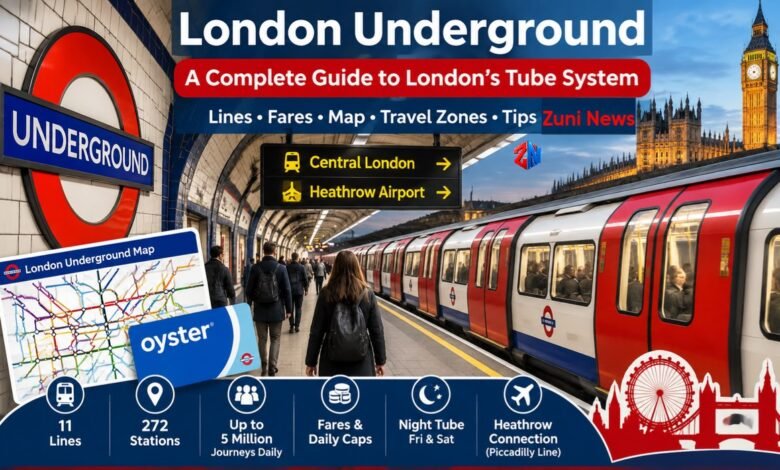
The London Underground, commonly known as the London Tube, is one of the most recognizable public transportation systems in the world. It connects central London with surrounding neighbourhoods, business districts, residential areas and major tourist destinations. Whether you are visiting London for the first time or planning to use its trains regularly, understanding the Tube can make travelling around the city considerably easier.
The network has 11 different lines, hundreds of stations and connections to other transport services. This guide explains how the Underground works, where its lines travel, how to purchase tickets, what the travel zones mean and how visitors can plan their journeys.
What Is the London Underground?
The London Underground is an urban railway system operated by Transport for London (TfL). People commonly call it the Tube because many sections of its railway run through underground tunnels.
However, not every train travels below ground. Several routes also operate above the surface, particularly in London’s outer neighbourhoods.
According to Transport for London, the network has:
- 11 Underground lines
- 402 kilometres of railway
- 272 stations
- Up to 5 million passenger journeys per day
The Underground serves commuters, students, residents and international visitors. It connects important locations across the capital, making it possible to travel between major destinations without depending entirely on taxis or road transport.
It also connects with London’s buses, National Rail services, the Docklands Light Railway (DLR), London Overground and Elizabeth line.
London Underground Lines and Their Routes
The Underground consists of 11 colour-coded lines. Each has its own route, stations and connections with other services.
Here is an overview of the main lines:
| Underground Line | Main Route or Area |
|---|---|
| Bakerloo Line | Harrow & Wealdstone to Elephant & Castle |
| Central Line | West Ruislip and Ealing Broadway to Epping and Hainault through central London |
| Circle Line | Hammersmith and Edgware Road through central London’s circular route |
| District Line | Richmond, Ealing Broadway, Wimbledon and Kensington Olympia branches through central London towards Upminster |
| Hammersmith & City Line | Hammersmith to Barking |
| Jubilee Line | Stanmore to Stratford |
| Metropolitan Line | Aldgate to Uxbridge, Watford, Amersham and Chesham through different branches |
| Northern Line | Edgware, High Barnet and Mill Hill East branches towards Morden and Battersea Power Station |
| Piccadilly Line | Uxbridge and Heathrow Airport branches towards Cockfosters |
| Victoria Line | Walthamstow Central to Brixton |
| Waterloo & City Line | Waterloo to Bank |
Which London Underground Lines Should Visitors Know?
Some lines are particularly useful when exploring popular London destinations.
Piccadilly Line: This is an important route for international visitors because it connects Heathrow Airport with central London. It also serves areas such as Leicester Square, Piccadilly Circus and King’s Cross.
Central Line: It connects several major shopping and commercial areas, including Oxford Circus, Tottenham Court Road and Liverpool Street. Its western branches serve Ealing Broadway and West Ruislip, while its eastern branches extend towards Epping and Hainault.
Jubilee Line: This line serves Westminster, London Bridge, Canary Wharf and the popular entertainment district around North Greenwich.
Victoria Line: It provides a convenient connection between Victoria, Green Park, Oxford Circus and King’s Cross St Pancras.
Northern Line: It connects several important destinations, including Camden Town, Leicester Square, London Bridge and Waterloo.
The most suitable line depends on your starting station and destination. Sometimes changing trains is necessary to complete a journey.
Understanding the London Underground Map
The London Underground map is an essential tool for navigating the railway network. Its different coloured lines make it easier to identify routes, stations and connections.
One important detail is that the map is a schematic diagram rather than an accurate geographical street map. It focuses on showing railway connections and station order instead of representing actual distances.
How to Read the Tube Map
Understanding the map becomes easier when you know a few basic features:
- Coloured lines: Every Underground route has its own colour.
- Station names: These identify individual stops along each route.
- Interchange symbols: These indicate stations where passengers can change between different lines.
- Travel zones: Numbered zones help determine journey fares.
- Terminal stations: These help passengers identify the direction of their train.
For example, if you want to travel from King’s Cross St Pancras to Oxford Circus, you can use the Victoria Line without changing trains.
You should also check the direction displayed on the platform. Trains travelling on the same line can go in opposite directions, so choosing the correct destination is important.
The official TfL Tube map is available online and can be accessed through its website or mobile application.
How to Use the London Underground: Step-by-Step Guide
Using the Tube may seem confusing initially, especially if you have never travelled on a large underground railway system. However, the process is straightforward once you understand the basic steps.
Step 1: Find Your Starting and Destination Stations
First, identify the station closest to your current location and the station nearest your destination.
You can use the official TfL journey planner or a navigation application to find a suitable route.
Step 2: Identify the Correct Underground Line
Check the Tube map to determine which coloured line connects your starting station with your destination.
If there is no direct connection, the journey planner will show where you need to change trains.
Step 3: Follow the Platform Signs
Once inside the station, follow the signs for your selected line.
Pay attention to the final destination displayed on the signs and trains. This helps you select the correct direction.
Step 4: Enter the Station
Use your contactless payment card, mobile device or Oyster card at the yellow card reader to enter through the ticket gates.
Make sure your payment method is accepted before travelling.
Step 5: Board the Train
Wait behind the platform safety markings and allow passengers to leave before entering the train.
Check the station displays and announcements to confirm that you are boarding the correct service.
Step 6: Change Lines When Necessary
If your route requires a connection, follow the interchange signs inside the station.
You generally do not need to leave the station or pass through another ticket gate when changing between Underground lines within the same paid area.
Step 7: Exit at Your Destination
When you reach your destination, follow the exit signs and touch out using the same payment card or device you used to enter.
This final step is important because failing to touch out correctly can result in an incorrect fare.
London Underground Fares, Tickets and Payment Methods
Understanding the ticketing system is important for anyone planning to use public transport in London.
Transport for London offers several payment options, including contactless bank cards, mobile payments and Oyster cards.
1. Contactless Payment
Contactless payment is one of the easiest ways to travel on the Underground.
You can use an eligible contactless bank card or a compatible smartphone or smartwatch.
Simply touch the yellow reader when entering and leaving the station. The correct fare is calculated automatically.
Always use the same physical card or device for both parts of your journey. For example, do not touch in using your smartphone and then touch out using the physical bank card connected to it.
2. Oyster Card
An Oyster card is a rechargeable smartcard designed for travelling around London.
You can add credit to the card and use it on the Underground and other participating transport services.
It is particularly useful for visitors who prefer not to use their bank cards for everyday travel.
3. Visitor Oyster Card
International visitors can also consider a Visitor Oyster card.
It is a prepaid travel card that can be purchased before arriving in London. It provides a convenient way to pay for journeys without repeatedly purchasing individual tickets.
Understanding Peak and Off-Peak Fares
London Underground fares depend on several factors, including the distance travelled, travel zones and time of day.
According to TfL’s 2026 fare information, standard peak times for pay-as-you-go rail travel are:
- Monday to Friday: 6:30 am to 9:30 am
- Monday to Friday: 4:00 pm to 7:00 pm
These periods do not include public holidays. Peak and off-peak fares are determined by the time you touch in at the beginning of your journey.
Off-peak fares generally apply at other times. However, passengers travelling from a station outside Zone 1 into Zone 1 between 4:00 pm and 7:00 pm on weekdays may qualify for off-peak fares under TfL’s special evening rule.
All Tube and Elizabeth line journeys to and from Heathrow Airport are charged peak fares if they start, end or pass through Zone 1.
London Underground Single Ticket Prices in 2026
The following table shows standard adult pay-as-you-go single fares for journeys in Zones 1–6. The price depends on how many zones you travel through and whether your journey includes Zone 1.
| Zones Travelled | Peak Including Zone 1 | Off-Peak Including Zone 1 | Peak Excluding Zone 1 | Off-Peak Excluding Zone 1 |
|---|---|---|---|---|
| 1 Zone | £3.10 | £3.00 | £2.30 | £2.20 |
| 2 Zones | £3.60 | £3.10 | £2.50 | £2.30 |
| 3 Zones | £3.90 | £3.30 | £3.20 | £2.40 |
| 4 Zones | £4.80 | £3.60 | £3.40 | £2.50 |
| 5 Zones | £5.30 | £3.80 | £3.80 | £2.60 |
| 6 Zones | £5.90 | £4.00 | — | — |
These are adult pay-as-you-go fares. Concessionary fares, cash tickets and journeys involving special fare rules may have different prices.
Daily and Weekly Travel Caps
One useful feature of London’s payment system is fare capping.
Daily and weekly caps limit how much eligible adult passengers pay when making multiple journeys using contactless or Oyster pay-as-you-go payment.
The following are the 2026 daily and weekly caps:
| Travel Zones | Daily Cap | Weekly Cap (Monday to Sunday) |
|---|---|---|
| Zones 1–2 | £8.90 | £44.70 |
| Zones 1–3 | £10.50 | £52.50 |
| Zones 1–4 | £12.80 | £64.20 |
| Zones 1–5 | £15.30 | £76.40 |
| Zones 1–6 | £16.30 | £81.60 |
Once you reach the applicable cap, additional eligible journeys within that period do not increase the amount charged.
The daily cap operates over a 24-hour transport day, starting at 4:30 am and ending at 4:29 am the following day. The weekly cap applies to a fixed Monday-to-Sunday period rather than any seven consecutive days.
This can be helpful for tourists who plan to visit several attractions in one day.
Always check the applicable fare for your journey because prices and special fare conditions can vary depending on the route and transport service.
London Travel Zones Explained
London’s public transport network uses nine numbered travel zones.
Zone 1 covers central London, while the other zones extend towards the surrounding areas.
The zones are important because the fare for many Underground journeys depends on which zones you travel through.
For example:
- Zone 1 includes many central London destinations.
- Zone 2 covers neighbourhoods surrounding the central area.
- Zones 3 and 4 extend further into Greater London.
- Zones 5 to 9 cover more distant suburban locations.
Most major tourist attractions are located in Zones 1 and 2. Therefore, visitors staying in central London may not need to travel through many different zones.
However, airports and destinations outside central London can require journeys through additional zones.
Before travelling, check the station locations on the official Tube map and use TfL’s fare finder to calculate the cost.
London Underground Opening Hours and Night Tube
The London Underground does not operate on one universal timetable. Opening and closing times depend on the line, station, day and direction of travel.
Most regular services operate from early morning until around midnight, but exact first and last train times vary.
Passengers should check individual station timetables before planning late-night journeys.
What Is the Night Tube?
The Night Tube provides overnight Underground services on selected routes.
It operates on Friday and Saturday nights, allowing passengers to travel during hours when many regular services would otherwise have finished.
The Night Tube operates on the Jubilee and Victoria lines and on most of the following three lines:
- Central Line
- Northern Line
- Piccadilly Line
Not every station or section of these lines necessarily receives overnight service.
Night Tube fares are charged at off-peak rates. Passengers should check the latest TfL Night Tube map and service information before travelling.
Travelling Between Heathrow Airport and Central London
Heathrow Airport is one of London’s main international airports and has direct access to the Underground network.
The Piccadilly Line connects Heathrow with central London, making it a practical option for passengers arriving from other countries.
There are Underground stations serving Heathrow Terminals 2 and 3, Terminal 4 and Terminal 5.
The journey to some central London destinations takes approximately 50 minutes, although the exact duration depends on your destination, airport terminal and service conditions.
Passengers can pay using contactless cards, mobile devices or Oyster cards.
The Elizabeth line also serves Heathrow Airport and provides another rail connection to central London. However, it is a separate railway service rather than one of the 11 London Underground lines.
One important detail for late-night travellers is that the Night Tube does not serve Heathrow Terminal 4. Overnight Piccadilly Line services serve Heathrow Terminals 2 and 3 and Terminal 5, subject to the operating timetable.
Choosing between the available services depends on your budget, destination, luggage and preferred journey time.
Accessibility on the London Underground
The Underground provides several accessibility features, but not every station offers step-free access.
Some stations have lifts, ramps and level-access platforms, while others require passengers to use stairs or escalators.
If you use a wheelchair, travel with a pushchair or have limited mobility, it is important to check your route before leaving.
TfL provides an official step-free Tube guide and accessibility information through its TfL Go application.
Before travelling, consider checking:
- Whether your starting station has step-free access.
- Whether your destination station has suitable facilities.
- Whether interchange stations offer accessible connections.
- Whether lifts are operating normally.
- Whether there are significant gaps or steps between platforms and trains.
Remember that a station being step-free does not always mean every platform or interchange is fully accessible.
Planning your return journey is equally important because the accessible route may differ depending on the direction of travel.
History of the London Underground
The London Underground has a fascinating history that goes back more than 160 years.
Its development began during the nineteenth century, when London’s growing population created a need for better transportation.
The World’s First Underground Railway
On 10 January 1863, the Metropolitan Railway opened the world’s first underground railway.
Its original route connected Paddington, then known as Bishop’s Road, with Farringdon Street.
The railway initially used steam-powered trains, which was a major engineering achievement for its time.
The Introduction of Electric Underground Trains
In 1890, the City and South London Railway opened the world’s first deep-level electric railway.
This development helped establish the foundations of the modern electric underground railway system.
The Famous Tube Map
In 1933, designer Harry Beck introduced a new diagram of the Underground network.
His design simplified the complicated railway system by using coloured lines, clear station names and easy-to-follow connections.
The diagram became one of the most recognizable transport maps in the world and continues to influence how modern metro networks present their routes.
The Underground Today
Over the years, the network has expanded through new stations, improved trains, upgraded signalling systems and better passenger facilities.
Today, the London Underground remains an essential part of the city’s transportation infrastructure.
Practical Tips for First-Time London Underground Users
If you are visiting London for the first time, a little preparation can make your Tube journeys easier and more comfortable.
Here are some useful recommendations:
1. Download a Travel Application: Use TfL Go to check routes, train services, station information and live disruptions.
2. Check the Journey Before Leaving: Some routes have multiple branches, so confirm your train’s destination before boarding.
3. Avoid Busy Periods When Possible: Morning and evening peak periods can be particularly crowded. If your schedule is flexible, travelling outside these hours may provide a more comfortable experience.
4. Use the Same Payment Method: Always use the same card or device when touching in and out.
5. Check Service Disruptions: Engineering work, maintenance and unexpected incidents can affect individual lines or stations.
6. Allow Extra Time for Connections: Large interchange stations can require considerable walking between platforms.
7. Keep Your Belongings Secure: Like any busy public transport system, the Underground requires passengers to remain aware of their surroundings and personal belongings.
8. Compare Walking and Train Routes: Some central London destinations are relatively close together. Walking may sometimes be more convenient than taking a train for a very short journey.
The key is to plan ahead, follow station signs and check updated travel information before setting off.
Overall, the London Underground is an efficient way to explore the capital. Once you understand its lines, payment methods and travel zones, navigating the network becomes much easier.
Also Read: Wandsworth Prison: Visiting Times, Contact Details, History & Latest Conditions
Frequently Asked Questions
How many lines does the London Underground have?
The London Underground has 11 lines, covering approximately 402 kilometres and serving 272 stations.
What is the London Underground commonly called?
It is commonly known as the London Tube or simply the Tube. The name comes from the underground tunnels through which many of its trains travel.
How much does a London Underground ticket cost?
In 2026, standard adult pay-as-you-go single fares for journeys including Zone 1 start at £3.00 during off-peak hours and £3.10 during peak hours. The exact fare depends on the number of zones travelled and the time of day. The daily cap for Zones 1–2 is £8.90. Contactless and Oyster pay-as-you-go options are convenient choices.
Does the London Underground operate 24 hours a day?
No, most Underground lines do not operate throughout the night. However, the Night Tube provides overnight services on selected lines during Friday and Saturday nights.
Can I travel from Heathrow Airport to central London using the Underground?
Yes. The Piccadilly Line connects Heathrow Airport with central London and serves Terminals 2 and 3, Terminal 4 and Terminal 5. However, Terminal 4 is not served by the Night Tube.
When did the London Underground first open?
The first underground railway opened on 10 January 1863. It operated between Paddington and Farringdon Street and was the world’s first underground railway.