

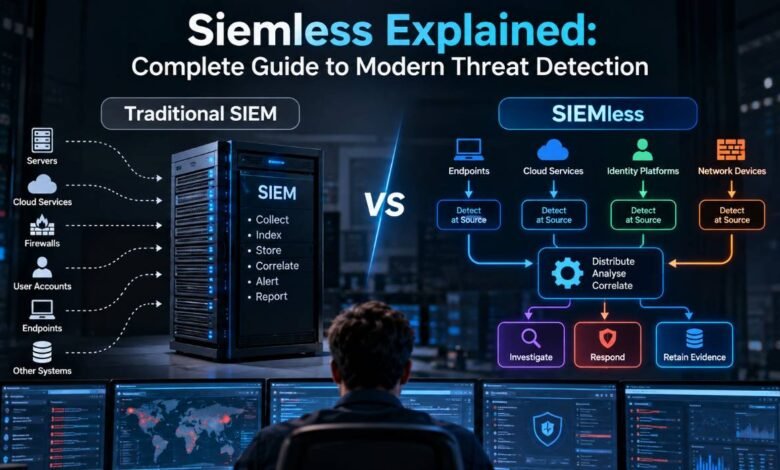
Siemless is a term used in cybersecurity for security monitoring that does not depend on a conventional, all-in-one Security Information and Event Management (SIEM) system. It is usually written as SIEMless or SIEM-less. Rather than forcing every security event through one central platform before analysis, some distributed designs detect suspicious behaviour near its source or while data is moving through a pipeline.
Different companies use the term for different products. Removing a traditional SIEM does not remove the need for logs, investigations or human expertise. Understanding these differences helps organisations decide whether a modern alternative is genuinely useful.
What Does Siemless Mean in Cybersecurity?
SIEM stands for Security Information and Event Management. A conventional SIEM collects information from servers, cloud services, firewalls, user accounts and other systems. It helps analysts spot threats, investigate incidents and produce audit records.
In broad terms, this approach means delivering some or all of these security functions without relying on the usual central SIEM as the main processing hub. Detection may happen at endpoints, within cloud services or during data transmission. Selected findings are then brought together for investigation and response.
It is not a single, universally defined technology. The architecture matters more than the label.
Not to Be Confused with Seamless
Seamless means smooth or without interruption. SIEMless contains the cybersecurity acronym SIEM. The words are not interchangeable.
Why Are Organisations Exploring SIEM Alternatives?
Traditional SIEM platforms remain valuable for searching events and generating reports, but processing data from many systems can be challenging.
Cloud applications, laptops and firewalls all produce useful security records. Combining them matters, but centralising every raw event may be unnecessary.
Common concerns include ingestion charges, storage requirements, time spent maintaining detection rules and overwhelming numbers of alerts. These approaches attempt to separate the activities that must happen immediately from those that can use more economical long-term storage.
Central monitoring is not obsolete. Organisations with modest data volumes may see little benefit from changing.
How Does a SIEMless Architecture Work?
A typical distributed design moves detection closer to the systems producing security information while preserving ways to investigate activity across the organisation. Not every product follows this design; some still use centralised storage, correlation engines or other SIEM-like components.
1. Collect Security Signals
Sources include endpoint tools, identity platforms, cloud services and firewalls. Reliable connectors are essential.
2. Normalise and Enrich Events
Events are mapped into fields such as user, device, timestamp and action. The Open Cybersecurity Schema Framework (OCSF) can help different tools interpret records consistently.
3. Detect Threats at the Source or in Transit
Rules, behavioural analytics or other detectors examine events before they necessarily enter a central indexed database. For example, repeated failed logins followed by an unusual successful login may trigger an alert.
This reduces dependence on bulk ingestion, but detection still requires accurate signals and cross-source correlation.
4. Investigate, Respond and Retain Evidence
A security operations centre (SOC) investigates alerts and gathers evidence. Responses might include disabling compromised accounts or isolating devices.
Raw records can remain in secure storage for audits. High-impact automated actions need safeguards and oversight.
SIEM vs SIEMless: What Is the Difference?
| Feature | Traditional SIEM | SIEMless-Style Approach |
|---|---|---|
| Main processing | Often relies on central collection and indexing | May analyse at the source or in transit |
| Data storage | Commonly integrated with the analysis platform | Can separate detection from long-term retention |
| Investigation | Usually provides one central investigation interface | Depends on integrations and cross-source search |
| Cost model | May depend on ingestion, capacity or licensing | Varies by provider and infrastructure |
| Best fit | Teams wanting established central workflows | Teams needing flexible processing across many sources |
Neither model guarantees better security. Modern SIEMs already offer filtering and automation, while distributed systems can require considerable engineering.
Potential Benefits of Distributed Security Monitoring
More Flexible Detection
Processing events near their source can help surface certain threats without waiting for large batches of logs to reach a central index. The improvement varies according to the connection, detector and workload.
Better Control Over Data
Processing and storing records in different locations may help with data-location needs. Sensitive information still requires protection.
Opportunity to Reduce Waste
Filtering low-value events may reduce expenses, but total costs must include staff, engineering, storage and investigations.
Adaptability Across Environments
Distributed collection may suit businesses spanning offices, cloud platforms and remote devices.
Limitations and Risks You Should Know
The greatest misconception is that SIEMless means logless. It does not. Organisations still need trustworthy records to reconstruct incidents, investigate suspicious activity and meet applicable obligations.
Official multi-agency guidance on event logging recommends secure retention, centralised access or aggregation where appropriate, strong log integrity and a detection strategy. A distributed architecture must provide equivalent practical access without creating blind spots.
Another risk is fragmented visibility. A single unusual login may appear harmless until it is connected with a suspicious cloud download and a new administrator account. If tools cannot correlate those events, decentralisation may weaken detection instead of improving it.
Automation is another area for caution. Incorrectly isolating a production server can disrupt operations. Good systems support testing, permission controls, approval requirements and records of automated actions.
Switching platforms also creates ongoing integration and maintenance work.
Companies and Products Using the Name
Not necessarily. The name appears in several separate cybersecurity contexts, and these should not be treated as one business.
Alert Logic SIEMless Threat Management
Alert Logic announced a service called SIEMless Threat Management in November 2018. It presented managed detection, monitoring and expert support as an alternative for organisations struggling with conventional SIEM tools.
That historical launch does not, by itself, describe the service’s current availability.
BluSapphire SIEMless Architecture
BluSapphire uses SIEMless for its distributed, AI-oriented security architecture, describing detection close to data sources and a central system for correlating important signals.
Its published speed and cost figures are vendor claims, not guarantees for every deployment.
ReliaQuest GreyMatter SIEM-Less
In July 2026, ReliaQuest announced GreyMatter SIEM-Less, which it says can detect threats while data is moving, let organisations choose where security records are stored and support investigations across different systems.
Its claims about faster detection and lower costs should be assessed against independent testing and each organisation’s needs.
Rushing Technologies SiemLess Project
Rushing Technologies separately describes a publicly available, self-hosted security monitoring project named SiemLess.
Its published case study describes a self-hosted stack using FastAPI, PostgreSQL, Redis and YAML detection rules. The project is presented as a self-hosted SIEM tool and deliberately uses a database for log search, unlike some distributed architectural proposals.
Provider identity and architecture should be checked before choosing any offering.
Who Might Benefit from Distributed Threat Detection?
Large organisations with numerous cloud services, high event volumes or strict data-handling requirements may find distributed monitoring worth evaluating.
Teams already operating several security tools may also benefit if a new approach reduces duplicated collection.
Smaller businesses without dedicated analysts may prefer managed detection, which does not necessarily use a distributed architecture.
For a small IT team, a conventional SIEM or cloud-native service may be easier to manage. Risks, skills and budget should decide.
How to Evaluate and Adopt the Approach Safely
Start with outcomes instead of products. Identify the threats the organisation must detect, the evidence needed for investigations and the records it must retain.
Then follow a controlled evaluation:
- Map existing coverage. List important devices, identities, applications and current detection rules.
- Check integrations. Confirm supported sources, event formats and the ability to correlate activity across systems.
- Test realistic scenarios. Measure detection time, missed incidents, false alerts and investigation effort using authorised test activity.
- Review evidence handling. Verify retention settings, secure access, tamper protection and practical searching of older records.
- Compare full costs. Include licensing, storage, cloud queries, engineering support, training and incident response.
- Run systems in parallel. Keep proven monitoring active until the replacement has demonstrated equivalent or better coverage.
A pilot should also define responsibility for failed connectors, containment approvals and outages.
The Future of Modern Security Operations
Security monitoring increasingly combines flexible data pipelines, automation and endpoint, identity and cloud signals. AI may help organise evidence, but cannot replace reliable records.
Rather than abandoning every SIEM, organisations may combine modern SIEMs, data lakes, distributed detection and managed services.
Conclusion
This approach reflects a useful shift in how security detection can be organised, but it is neither a promise of zero logs nor a shortcut to guaranteed savings. It can mean a distributed architecture, a managed service or a particular software project, depending on the context.
For buyers and security teams, the priority is to verify how an offering gathers evidence, detects real attacks, supports investigations and maintains essential records. A sound security design matters more than the label attached to it.
Also Read: Visionics Explained: The Remarkable Technology, Software, Services and Company History
Frequently Asked Questions
What is Siemless in simple terms?
It usually refers to cybersecurity monitoring that performs important detection and response functions without depending entirely on a traditional central SIEM platform. The term also appears in individual product names.
Is SIEMless better than a traditional SIEM?
Not automatically. A distributed design may offer more flexibility or lower costs for certain environments, while a conventional SIEM can provide established search, reporting and investigation workflows. Testing is the best way to compare them.
Does Siemless eliminate the need for security logs?
No. Log records remain important for investigations, incident reconstruction and audits. This arrangement may process and store those records differently, but it still needs to protect and retrieve them.
Is SIEMless the same as XDR or SOAR?
No. Extended Detection and Response (XDR) connects detection across multiple security areas, while Security Orchestration, Automation and Response (SOAR) helps coordinate actions. Either may be part of a distributed architecture, but the terms describe different capabilities.
Can a small business use Siemless?
Yes, depending on the service and the organisation’s skills. A small team should prioritise manageable monitoring, reliable alerts, expert support when required and predictable costs rather than buying a complicated architecture.
Is Siemless an open-source tool?
Rushing Technologies publishes code for a project named SiemLess, but a publicly accessible repository does not, by itself, confirm an open-source licence. The broader approach also appears in commercial offerings. The name alone does not establish a product’s licence or availability.