

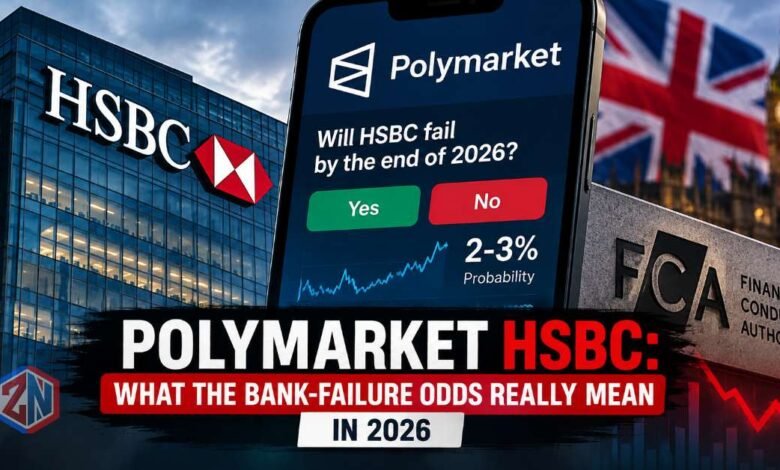
Polymarket HSBC is drawing attention because traders on the prediction-market platform can take positions on whether HSBC will “fail” by the end of 2026. The market has become a UK regulatory talking point, but its price should not be read as proof that HSBC is close to collapse.
In early October 2026, the HSBC outcome was trading in the low-single-digit range, while total volume across the wider bank-failure market was only around $77,000. The bigger story is the debate over whether prediction markets tied to bank collapses could create risks around rumours, manipulation, insider information and public confidence.
What Does Polymarket HSBC Mean?
The phrase refers to a Polymarket contract asking whether HSBC will fail before the end of 2026. HSBC is one of several banks in a wider market that also covers lenders such as Lloyds, JPMorgan Chase, BNP Paribas and Wells Fargo.
Polymarket uses binary “Yes” and “No” contracts. Its help centre says displayed probabilities generally come from the midpoint of the bid-ask spread in the order book, or the last traded price when the spread is unusually wide. In simple terms, the percentage is produced by traders and market liquidity.
It is not a probability set by HSBC, the Bank of England, the Financial Conduct Authority or a credit-rating agency.
That distinction matters because a relatively thin market can move sharply when only a small number of orders change.
What Counts as an HSBC “Failure” on Polymarket?
The word “failure” sounds broad, but the market rules use a specific definition.
The HSBC contract can resolve “Yes” if a qualifying event occurs within the stated period. Examples include a regulator formally declaring the bank insolvent or non-viable, a court-ordered liquidation, statutory resolution, a regulator-mandated wind-down, a qualifying default that directly leads to resolution, or a compulsory transfer of substantially all assets and liabilities because of the bank’s financial condition.
A falling share price would not automatically qualify. Neither would weak earnings, a rating downgrade or deposit outflows unless events developed into one of the formal failure conditions in the rules.
So the contract is not simply asking whether HSBC will have a difficult year. It is asking whether an extreme, legally recognisable failure event will occur.
What Are the Current Polymarket HSBC Odds?
In early October 2026, recent Polymarket data and reporting placed HSBC’s displayed probability at roughly 2% to 3%. The wider bank-failure market had generated around $77,000 in total trading volume, while the HSBC-specific outcome represented only a small part of that activity.
These figures can change quickly, so they should be treated as a snapshot rather than a fixed forecast.
Liquidity also matters. A displayed probability can look precise, but that does not guarantee deep market confidence. In a lightly traded contract, relatively small orders may have an outsized effect on the price.
A Polymarket percentage is therefore best treated as the current price at which participating traders are willing to transact. It is not the same as an actuarial default probability, a regulator’s solvency assessment or a bank stress-test result.
Does the Polymarket Market Mean HSBC Is in Financial Trouble?
Not by itself.
HSBC’s first-half 2026 results reported profit before tax of $19.5 billion and a Common Equity Tier 1 capital ratio of 14.1%. The bank also said it intended to manage its CET1 ratio within a medium-term range of 14% to 14.5%.
Those figures do not guarantee that HSBC cannot face future stress, but they provide important context.
The Bank of England’s July 2026 Financial Stability Report also said the UK banking system was strong enough to support households and businesses through stress. That was a system-wide assessment, rather than a specific prediction about HSBC.
The careful conclusion is that the existence of a Polymarket HSBC contract is not evidence that HSBC is expected to fail. It shows that traders can take positions on that possibility.
Why Are UK Regulators Paying Attention?
The controversy is less about the current HSBC odds and more about what could happen if bank-failure markets became much larger.
Banks depend heavily on confidence. Modern digital banking allows customers to move money quickly, while social media can spread rumours at enormous speed.
Critics worry that prediction markets add another element: participants may potentially profit from a worsening perception of a bank’s survival prospects.
UK Treasury Committee member Bobby Dean has raised concerns that rapidly rising bank-failure prices could amplify panic or potentially be exploited by bad actors. The Financial Conduct Authority has also been engaging with international regulators over prediction markets and market integrity.
There is no evidence that the HSBC or Lloyds contracts have caused a bank run. The current concern is about how these products might behave if their size and influence increase.
Could a Prediction Market Help Trigger a Bank Run?
In theory, it could become part of a feedback loop, although there is no evidence this has happened with HSBC.
Imagine a bank-failure contract suddenly moving from 2% to 15%. Screenshots spread online without context. Some people assume informed insiders know something serious. A few depositors withdraw money “just in case.”
If concern grows, the market price may rise further and attract even more attention.
This is why a bank-failure contract can be more sensitive than a market about sports or entertainment. A prediction about a bank can potentially interact with the confidence on which that bank depends.
Supporters make the opposite case. Polymarket says its markets operate peer-to-peer and prices are determined by supply and demand between participants rather than being set by the platform.
The policy question is whether that information value outweighs risks such as manipulation, misinformation or self-reinforcing panic.
What Is the FCA’s Position on Prediction Markets?
The FCA’s 2026 perimeter report provides important context for UK readers.
The regulator says prediction-market products linked to non-financial events may fall under the Gambling Commission’s remit, while contracts referencing financial events can fall within the FCA’s regulatory perimeter.
The FCA’s current view is that the financial prediction-market products it has seen are binary options. Those products remain subject to the FCA’s permanent ban on their sale to UK retail consumers.
Polymarket’s own geographic-restrictions page also lists the United Kingdom as a blocked location on its international platform. It says VPNs or similar tools must not be used to bypass geographic restrictions.
For someone searching for Polymarket HSBC from the UK, that regulatory and access context is at least as important as the headline probability.
Why the HSBC Odds Need Context
There are four important points to remember.
First, volume matters. A relatively small market can be easier to move than a deep financial market with thousands of active participants.
Second, contract wording matters. “HSBC fails” has a defined resolution test and does not simply mean that HSBC experiences financial weakness or a drop in its share price.
Third, traders may have different motives. Some are making genuine forecasts. Others may be hedging, speculating on short-term price movements or taking a small position because the potential payout is large.
Fourth, prediction markets are not bank regulators. Capital ratios, company filings, regulatory assessments, bond markets and credit-risk instruments all provide different information about a bank’s resilience.
A Polymarket price can therefore be viewed as one signal of trader sentiment, but it should not be treated as a standalone diagnosis of HSBC’s financial health.
Polymarket vs Traditional Bank-Risk Measures
Traditional bank-risk indicators include credit default swap prices, bond spreads, equity prices, capital ratios and regulatory stress tests.
Each measures a different part of financial risk.
Polymarket is much simpler. It compresses the question into a binary outcome: did the defined failure event happen before the deadline, yes or no?
That simplicity makes the contract easy to understand and share, but it also removes important nuance.
For example, a 3% prediction-market price is not automatically equivalent to a formally modelled 3% probability of default.
The two figures may look similar on a screen while being produced through very different methods, participants and assumptions.
What Should Readers Watch Next?
The most important signals are not one-day moves of a percentage point or two.
More meaningful developments would include a large rise in trading volume, a sustained increase in the HSBC contract alongside credible financial news, new action from the FCA or other regulators, or material changes in HSBC’s capital, funding, earnings or credit quality.
Readers should also distinguish between rumours circulating online and information contained in regulatory filings, official company results and announcements from financial authorities.
Until stronger evidence appears, the Polymarket HSBC market is better understood as part of a wider debate about prediction markets and financial stability than as a reliable warning that HSBC is about to collapse.
Bottom Line
The Polymarket HSBC story is real, but the most dramatic interpretation is not supported by the available evidence.
Traders can take positions on whether HSBC will meet a tightly defined failure condition by the end of 2026. Recent prices have shown only a low-single-digit displayed probability, and trading volume remains small compared with mainstream financial markets.
The bigger issue is regulatory: whether bank-failure prediction markets could create incentives for manipulation or amplify public panic.
For readers, the key is to separate a market price from a banking fact. Polymarket shows what participating traders are currently willing to pay for a binary outcome. It does not, by itself, show that HSBC is failing.
Also Read: Ksenia Maximova Biography: The Powerful Story of a Model, Councillor and Anti-War Activist
FAQ
What is Polymarket HSBC?
Polymarket HSBC refers to a prediction-market contract that lets traders take “Yes” or “No” positions on whether HSBC will meet Polymarket’s defined bank-failure conditions by the end of 2026.
What are the HSBC failure odds on Polymarket?
In early October 2026, the HSBC outcome was in the low-single digits, roughly 2% to 3%. The price can change as traders place, cancel or execute orders.
Does Polymarket predict that HSBC will collapse?
No. The displayed price reflects trading activity among market participants. It is not an official forecast from HSBC, the FCA, a credit-rating agency or the Bank of England.
Is Polymarket legal for UK users?
Polymarket’s international platform lists the UK as a restricted location. The FCA also says financial prediction-market products it has examined are binary options, whose sale to UK retail consumers is banned.
Why are regulators concerned about bank-failure prediction markets?
Critics worry that rapidly rising bank-failure prices could spread through social media, amplify rumours or create opportunities for manipulation. Regulators are therefore paying attention to market integrity and potential financial-stability effects.





One Comment