
Lucy Macintosh: Remarkable Story of Historian Lucy Mackintosh, Shifting Grounds and Awards

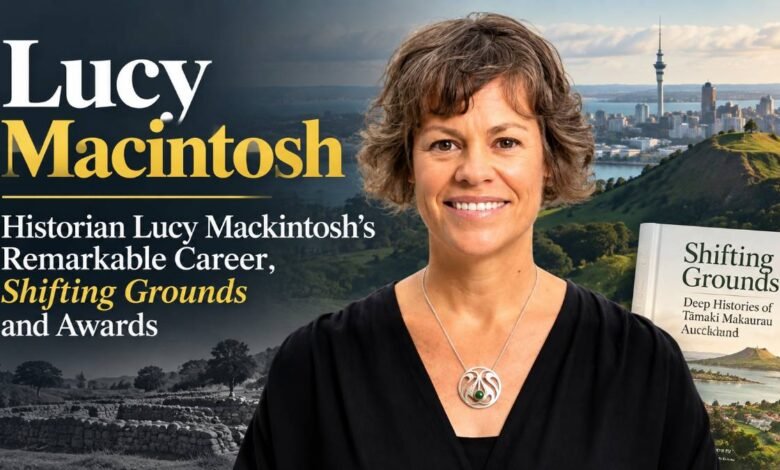
People searching for “Lucy Macintosh” may be looking for Dr Lucy Mackintosh, the New Zealand historian, curator and author known for her work on the layered histories of Tāmaki Makaurau Auckland. The correct spelling of her surname is Mackintosh. Her career has focused on public history, heritage, museums, landscapes and the ways physical places can preserve stories that conventional written records sometimes overlook.
Mackintosh is best known for her 2021 book Shifting Grounds: Deep Histories of Tāmaki Makaurau Auckland. The book grew out of her doctoral research and brought wider attention to her place-based approach to history. Rather than treating Auckland’s landscape as a background to events, she studies the land itself as historical evidence, combining geography, archaeology, material culture, mātauranga Māori and written records.
Quick Bio
| Field | Details |
|---|---|
| Full Name | Lucy Mackintosh |
| Profession | Historian, curator and author |
| Field | Cultural, environmental and place-based history |
| Education | MA in History and PhD in History, University of Auckland |
| Known For | Shifting Grounds: Deep Histories of Tāmaki Makaurau Auckland |
| Former Role | Curator of History, Auckland War Memorial Museum |
| Later Museum Work | Senior Research Fellow at Auckland Museum; Curator New Zealand Histories and Cultures at Te Papa |
| Major Awards | Ernest Scott Prize, Ian Wards Prize, NZSA Heritage Book Award for Non-Fiction |
| Main Research Focus | Tāmaki Makaurau Auckland, landscape, heritage, memory and material culture |
Who Is Lucy Mackintosh?
Lucy Mackintosh is a New Zealand public historian whose work connects academic research with public-facing history. She has worked with museums, heritage organisations and government agencies, giving her career a practical dimension beyond university research.
Her work asks how cities remember their past and what happens when important histories are absent from monuments, books or familiar civic narratives. This has led her to study places in Auckland where Māori, colonial, environmental and community histories overlap.
A park, stonefield, garden, cottage site or monument can become evidence. For Mackintosh, the physical environment can reveal historical relationships that may not be obvious in official documents alone. Her research therefore treats landscapes not simply as scenery but as sources that can be examined alongside written archives.
Lucy Mackintosh’s Education and Academic Background
Mackintosh completed a master’s degree in history at the University of Auckland in 1994. Her postgraduate work developed an interest in environmental history and the relationship between people, industry and landscapes.
She later returned to doctoral study at the same university. Her PhD, completed in 2019, was titled Shifting Grounds: History, Memory and Materiality in Auckland Landscapes c.1350–2018. The doctoral project became the foundation for the book that established Mackintosh more widely as an author.
Her academic path is important because it helps explain the interdisciplinary nature of her later work. Instead of separating environmental, cultural and social history, Mackintosh examines how these different histories meet in specific places.
From Heritage Research to Museum Work
Before Shifting Grounds was published, Mackintosh had already spent many years researching history, heritage and material culture. University and museum profiles describe work for local and central government agencies as well as heritage organisations.
This experience brought her into direct contact with historic sites. Through heritage and museum work, she encountered places where local knowledge, surviving physical traces and official historical narratives did not always align neatly.
Mackintosh joined Auckland War Memorial Museum Tāmaki Paenga Hira as Curator of History in 2017. University of Auckland material later identified her as a Senior Research Fellow at the museum and noted that she served as Curator of History from 2017 to 2022.
Her museum work has included collections, research, exhibitions and public interpretation, allowing her to connect scholarly history with objects and stories presented directly to the public.
Work at Te Papa
A Museum of New Zealand Te Papa Tongarewa history-team profile lists Mackintosh as Curator New Zealand Histories and Cultures, appointed to cover the role while another curator was on parental leave. Te Papa says she arrived after three years as a Senior Research Fellow at Auckland Museum and five years as Curator of History there.
This reflects the continuing museum dimension of her career. Her expertise includes not only historical writing but also collections, exhibitions and educational resources.
Shifting Grounds: The Book That Defined Her Public Profile
Published by Bridget Williams Books in 2021, Shifting Grounds: Deep Histories of Tāmaki Makaurau Auckland explores three major Auckland landscapes: Pukekawa/Auckland Domain, Maungakiekie/One Tree Hill and the Ōtuataua Stonefields at Ihumātao.
Its central idea is that landscapes can function like archives. Instead of relying only on written records, Mackintosh draws meaning from volcanic landforms, gardens, buildings, monuments, pathways and other physical traces.
This allows the book to bring together natural and human history while making room for stories that can be overlooked when a city’s past is told mainly through official events.
Why the Three Landscapes Matter
Each location contains several layers of history. The Ōtuataua Stonefields connect to Māori cultivation and settlement, later colonial pressures and modern debates over land and development. Pukekawa/Auckland Domain contains stories involving Māori presence, colonial institutions, Chinese market gardening and the later creation of civic and recreational spaces.
Maungakiekie/One Tree Hill can similarly be read through Māori history, settler activity, agriculture, remembrance and changing ideas about how Auckland represents its past.
By placing these histories beside one another, Mackintosh challenges the idea that a familiar place has only one authoritative story. Her method encourages readers to consider who is remembered, who becomes less visible and how later development can obscure earlier layers of meaning.
Lucy Mackintosh and Ihumātao
Ihumātao is especially important in Mackintosh’s work. She researched the area before it became the subject of intense national attention during protests over proposed housing development.
Her historical writing emphasised the significance of the area’s surviving cultural landscape. The Ōtuataua Stonefields preserve evidence of long histories of cultivation, occupation and relationships between people and land.
This illustrates what makes her work distinctive. Heritage is not treated as something separate from present-day life. Historical events can continue to influence communities, planning decisions, questions about land and the way people understand a place today.
Awards and Recognition
Shifting Grounds received major recognition after publication. In 2022, Mackintosh was named a co-winner of the Ernest Scott Prize for History. The University of Melbourne awards the prize for distinguished original historical research relating to Australia, New Zealand or the history of colonisation.
The book also won the 2022 Ian Wards Prize, which recognises exemplary use of New Zealand archives and records. In the same year, it won the New Zealand Society of Authors Heritage Book Award for Non-Fiction and was a finalist in the Ockham New Zealand Book Awards.
Recognition continued in 2023, when the New Zealand Historical Association listed Mackintosh as the recipient of the Erik Olssen Prize for Shifting Grounds. The prize recognises an outstanding first book by an early-career or emerging historian.
These honours show that the book succeeded in scholarly and wider literary settings. Its contribution lies not simply in uncovering less familiar facts, but in connecting place, evidence and public memory in an accessible way.
What Makes Lucy Mackintosh’s Historical Approach Different?
Mackintosh is closely associated with place-based history. This approach begins with a location and asks what layers of human activity, memory, environment and power can still be discovered there.
Traditional historical research often starts with documents and reconstructs events. Mackintosh frequently begins with a place, examines what survives physically, and connects those traces with archives, archaeology, geography, material culture and other forms of knowledge.
This can be particularly useful in urban history because cities are constantly altered. Roads are built, gardens disappear, buildings are demolished and names change. Yet traces remain, and those traces can reveal histories that later development has made less visible.
Her work also demonstrates why public history matters. A city’s past is not only stored in libraries. It can shape identity, heritage protection, museum collections, land-use debates and the way communities understand where they live.
Is “Lucy Macintosh” the Same Person as Lucy Mackintosh?
For readers arriving through the keyword “Lucy Macintosh,” the historian’s surname is Mackintosh, with a “k” after “Mac.” University, museum and publishing sources consistently identify her as Lucy Mackintosh.
Search engines may still connect the spelling variation with the historian, but using the correct name is especially important when looking for her book, academic research or museum career.
Search phrases such as “Lucy Mackintosh historian”, “Lucy Mackintosh biography” and “Lucy Mackintosh Shifting Grounds” are therefore more precise.
Lucy Mackintosh’s Age and Personal Details
A precise birth date or age is not stated in the main institutional biographies covering Lucy Mackintosh’s academic, publishing and museum career. An exact age therefore should not be presented as verified without a credible source.
The strongest publicly documented information about Mackintosh concerns her professional life: historical research, museum work, education, publications and awards. Avoiding unsupported personal details helps prevent estimates from being repeated online until they are mistaken for fact.
Why Lucy Mackintosh’s Work Matters
Mackintosh has helped broaden how Auckland history can be told. Her research shows that landscapes are not empty stages on which history happens. They can carry physical evidence, memory and cultural meaning across generations.
That perspective is particularly relevant to Tāmaki Makaurau, where Māori history, colonisation, migration, urban growth and environmental change have reshaped many of the same spaces.
By reading these layers together, Mackintosh offers a richer explanation of how the modern city was formed. Her work asks readers to pay attention not only to what a landscape currently looks like, but also to what existed there before and which stories have become harder to see.
Her career also connects academic research with museums and public education. That combination makes her work accessible to people who may never read specialist historical scholarship but still want to understand the places around them.
Conclusion
Lucy Mackintosh is a New Zealand historian, curator and author whose reputation is closely tied to a landscape-based approach to the history of Tāmaki Makaurau Auckland. Her award-winning Shifting Grounds grew from doctoral research but reached a broader audience by using places such as Ihumātao, Pukekawa and Maungakiekie to uncover histories that conventional accounts can miss.
For anyone searching “Lucy Macintosh,” the essential point is that the historian’s correct name is Lucy Mackintosh. Her documented career spans heritage research, Auckland War Memorial Museum and museum work at Te Papa, while her major contribution lies in showing how land, objects, memory and written records can work together to tell deeper histories.
Also Read: Freddie Jackson Dies at 70: Inside His Powerful R&B Career, Health Struggles and Lasting Legacy
FAQ
What is Lucy Mackintosh known for?
Lucy Mackintosh is best known as a New Zealand historian, curator and author and for her 2021 book Shifting Grounds: Deep Histories of Tāmaki Makaurau Auckland.
Is Lucy Macintosh the correct spelling?
No. The historian’s surname is correctly spelled Lucy Mackintosh. “Lucy Macintosh” is a search variation, while authoritative museum, university and publishing sources use Mackintosh.
What is Shifting Grounds about?
Shifting Grounds explores the layered histories of Pukekawa/Auckland Domain, Maungakiekie/One Tree Hill and the Ōtuataua Stonefields at Ihumātao. It uses landscapes and material traces as important forms of historical evidence.
What awards has Lucy Mackintosh won?
Her book was a co-winner of the 2022 Ernest Scott Prize and won the 2022 Ian Wards Prize and 2022 NZSA Heritage Book Award for Non-Fiction. Mackintosh was also listed as the 2023 Erik Olssen Prize recipient.
Where has Lucy Mackintosh worked?
Her documented career includes government and heritage research, Auckland War Memorial Museum and the Museum of New Zealand Te Papa Tongarewa. She served as Auckland Museum’s Curator of History and later as a Senior Research Fellow.
How old is Lucy Mackintosh?
A verified date of birth is not given in the main institutional biographies reviewed, so a precise age should not be stated as fact without a reliable source.





One Comment