

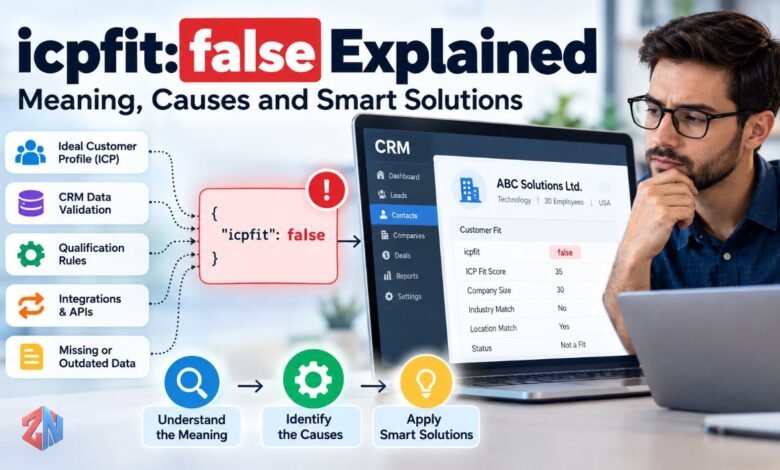
A field such as icpfit: false could appear in software configurations, business data, CRM systems, or application logs, depending on how a particular application defines it. At first glance, it looks like an error message. However, it can simply represent a negative result from a particular software condition or evaluation.
In sales-related applications, the term may refer to Ideal Customer Profile (ICP) matching. This process helps businesses identify potential customers who closely match their preferred audience. A negative result can indicate that a prospect does not satisfy certain qualification requirements.
However, the exact meaning depends on the software producing the value. The field name is not a universally established error code or standard configuration setting.
Understanding how this expression works can help users identify genuine customer mismatches, recognize inaccurate data, and troubleshoot unexpected results. This guide explains its meaning, possible causes, technical structure, and practical solutions.
What Does icpfit: false Mean?
The expression icpfit: false describes a field named icpfit with a negative Boolean value. In programming, Boolean values represent two logical states: true and false.
The field name determines what is being evaluated. The value indicates the result of that evaluation.
In a customer relationship management (CRM) environment, ICP commonly stands for Ideal Customer Profile. Under this interpretation, a false result may mean that a potential customer does not meet the organization’s established matching criteria.
For example, a software company might focus on businesses employing between 100 and 500 people. If a prospect employs only 30 people, the company’s evaluation rules could classify that prospect as a poor match.
Nevertheless, this interpretation cannot be confirmed without identifying the application. Another system could use the same field name for a different purpose.
Quick Overview
| Attribute | Explanation |
|---|---|
| Expression | icpfit: false |
| Value type | Boolean, when interpreted as a typed field |
| General meaning | A negative condition or disabled setting |
| Possible ICP meaning | Ideal Customer Profile fit |
| Possible context | CRM, customer qualification, or application-specific data |
| Other possible contexts | APIs, configurations, application logs |
| Opposite Boolean value | true |
| Error status | Not necessarily an error |
| Recommended action | Verify the source and evaluation rules |
The important distinction is that a negative result does not automatically mean something is broken. It may simply reflect the expected outcome of a defined condition.
How Does icpfit: false Work?
Understanding the technical structure makes this expression easier to interpret.
A typical key-value pair contains a field name followed by its assigned value. The field identifies the information being stored, while the value describes its current state.
Boolean Values in JSON and YAML
The expression icpfit: false resembles a YAML mapping entry. YAML is a structured data format commonly used for configuration files.
In JSON, the equivalent field inside an object would appear as:
{"icpfit": false}
JSON requires quotation marks around property names, while Boolean values such as false remain unquoted.
The distinction between false and "false" matters. The first is a Boolean value, whereas the second is a text string.
Applications expecting a Boolean may reject a string or process it incorrectly.
Field capitalization also matters in many programming environments. For example, icpfit, icpFit, and ICPFit are not necessarily interchangeable.
Before modifying the field, developers should inspect the application’s documentation or data schema to understand its expected type and purpose.
Understanding Ideal Customer Profile Matching
An Ideal Customer Profile describes the businesses most suited to a company’s products or services.
Instead of approaching every potential customer equally, organizations can evaluate prospects against characteristics associated with successful customer relationships.
Common ICP matching criteria include company size, industry, geographical location, revenue range, technology requirements, and business needs.
Common Approaches to ICP Fit Scoring
Different sales platforms calculate customer fit differently.
Some systems use simple qualification rules. A company either meets the requirements or does not.
Others use weighted scoring models. They assign different importance to individual characteristics and calculate an overall score.
For example, a hypothetical B2B software company might evaluate prospects using industry compatibility, employee count, geographic availability, and existing software systems.
A suitable prospect could satisfy most criteria, while another might fail a required condition.
Importantly, a business with a negative ICP result is not necessarily an unsuitable customer. It may simply fall outside the organization’s preferred segment.
Where Can icpfit: false Appear?
The expression may appear in several environments, although no particular platform can be identified from the keyword alone.
CRM and Sales Automation Platforms
CRM systems organize customer records, manage sales opportunities, and support qualification processes.
Actual ICP features are documented by established platforms. HubSpot provides an Ideal Customer Profile Tier property, while Lusha offers an ICP Fit Score for assessing contacts and companies.
These examples demonstrate how customer-fit evaluation operates in real software. They do not establish that either platform uses the exact field icpfit: false.
A custom CRM or integration could use a Boolean property to represent whether an account passes a matching rule.
APIs and Application Logs
Application programming interfaces allow different software systems to exchange information.
An API might return a customer-fit field alongside company details, qualification scores, or processing results.
Application logs may also record the state of particular conditions.
However, a negative Boolean value does not explain why a condition failed. Additional fields, documentation, or diagnostic messages are often necessary.
Why Does icpfit: false Appear?
Several circumstances could produce a negative ICP fit result in an application that uses the field for customer qualification.
Customer Does Not Match the Target Profile
A genuine mismatch is one possible explanation.
A company may operate outside the preferred industry, have too few employees, or lack a business requirement that the product addresses.
In such circumstances, the negative result may be correct.
Missing or Outdated Customer Information
CRM systems frequently depend on information collected from forms, databases, and enrichment providers.
If employee numbers, locations, or industry classifications are missing or outdated, the system may evaluate a prospect incorrectly.
Some platforms return a negative result when required information is unavailable. Others distinguish incomplete records from confirmed mismatches.
Incorrect Qualification Rules
A poorly configured matching rule can produce unexpected outcomes.
For example, a company targeting businesses with at least 50 employees might accidentally configure a requirement for 500 employees.
This mistake could exclude otherwise suitable prospects.
Integration or Field Mapping Problems
Data synchronization can also affect qualification results.
An integration might transfer information into the wrong field, use an outdated company record, or fail to update a calculated property.
These issues should be investigated before changing the displayed value manually.
Difference Between True, False, Null and Unknown
Not all customer qualification states carry the same meaning.
| Value | General interpretation |
|---|---|
true |
The defined condition is satisfied |
false |
The defined condition is not satisfied |
null |
The value is explicitly absent or unspecified |
unknown |
A possible application-defined status indicating uncertainty |
| Missing field | No value was supplied for that property |
The exact business meaning depends on the application.
For example, a prospect with incomplete company information should not automatically be treated as unsuitable.
PostHog’s documented ICP scoring system uses an insufficient_data status when essential company information is unavailable, rather than automatically assigning a negative fit score. This illustrates why separating unknown results from negative assessments can improve data quality.
How to Troubleshoot icpfit: false
When an unexpected negative result appears, a structured investigation is more useful than immediately changing the value.
Step 1: Identify the Original Software
Determine where the expression appears.
It could come from a CRM dashboard, API response, configuration file, or application log.
Record the application name, relevant version, and surrounding field names.
These details help establish whether the value represents customer qualification, a feature setting, or another condition.
Step 2: Verify the Underlying Information
If the field represents ICP matching, inspect the customer record.
Check company size, industry, location, and other information used by the qualification process.
Compare those details with reliable records before assuming the result is incorrect.
Step 3: Examine ICP Qualification Rules
Review the conditions used to determine customer suitability.
Some systems require every condition to pass. Others calculate a score and compare it against a threshold.
Identify which condition produced the negative result, if the software exposes that information.
Step 4: Inspect Data Types and Integrations
Developers should check whether the field contains an actual Boolean or a string.
They should also inspect field mappings, API responses, synchronization settings, and validation rules.
A mismatch between expected and received data types can produce incorrect application behavior.
Step 5: Reevaluate the Record
After correcting inaccurate information or configuration rules, use the application’s supported process to recalculate customer fit.
Some systems update automatically. Others require a workflow, synchronization, or manual reassessment.
Avoid forcing the field to true without understanding how it is generated.
Step 6: Confirm the Result
Finally, compare the updated output against the documented qualification criteria.
Check whether the result is consistent and whether any downstream sales automation behaves as intended.
This final check helps prevent the same issue from affecting additional records.
ICP Fit vs Lead Scoring: What Is the Difference?
ICP fit and lead scoring are related concepts, but they answer different questions.
ICP fit generally evaluates how closely a prospect resembles the organization’s preferred customer.
Lead scoring may also consider engagement, purchasing behavior, or buying signals.
For example, a small business might repeatedly visit a software company’s pricing page. Its engagement may indicate strong interest, even if the company falls outside the preferred customer profile.
Conversely, a company might match every ICP requirement but show little evidence of current buying interest.
Platforms such as Lusha distinguish customer-fit scoring from activity-based signals.
Using both types of information helps sales teams avoid treating customer suitability and immediate purchase interest as identical.
Can a Prospect With False ICP Fit Still Become a Customer?
Yes. An unfavorable customer-fit assessment does not necessarily prevent a successful sale.
An ICP is a prioritization tool, not a guarantee of future customer behavior.
A prospect might have unusual requirements, operate in an emerging market, or represent a valuable opportunity outside the organization’s normal target segment.
Sales teams can review such accounts individually, considering genuine product suitability, commercial potential, and available resources.
However, repeatedly pursuing poorly matched customers can also create unnecessary work.
The appropriate response is to use the ICP result as one decision-making signal rather than an automatic rejection.
Best Practices for Reliable ICP Fit Evaluation
Accurate customer-fit evaluation begins with clearly defined qualification criteria.
Businesses should document essential customer characteristics and distinguish strict disqualifiers from preferences.
They should also establish a separate outcome for insufficient information whenever possible. This prevents missing data from being confused with genuine incompatibility.
Regularly reviewing customer records and matching rules is equally important. Company characteristics change, and qualification models may become outdated.
For more reliable automation, organizations can record when an evaluation occurred, which rules were used, and why a record failed.
A transparent system makes unexpected results easier to investigate and reduces the risk of incorrect customer prioritization.
Common Mistakes to Avoid
One frequent mistake is assuming that every negative Boolean value represents a software failure.
Another is changing the result to true without understanding the underlying condition.
Businesses should also avoid treating missing information as definitive proof of poor customer fit.
Finally, an ICP score should not be confused with a complete assessment of sales potential. Engagement, product suitability, purchasing requirements, and timing may provide additional context.
Conclusion
The expression icpfit: false generally indicates a negative Boolean state, but its precise meaning depends on the software that defines the field.
In CRM-related applications, it may represent an unsuccessful Ideal Customer Profile match. However, an unexpected result can also arise from incomplete information, incorrect qualification rules, or integration problems.
The most effective approach is to identify the source, verify customer data, review evaluation criteria, and confirm how the application processes the result.
Understanding these details helps businesses make better qualification decisions while avoiding unnecessary technical changes.
Also Read: Siemless Explained: Complete Guide to Modern Threat Detection
Frequently Asked Questions
What does icpfit: false mean in a CRM?
It may indicate that a customer or prospect does not satisfy the organization’s Ideal Customer Profile criteria. However, the exact interpretation depends on the CRM’s field definition and qualification rules.
Is icpfit: false a software error?
Not necessarily. A Boolean value of false can be a normal result. It becomes a concern when it contradicts verified information or causes unexpected application behavior.
Can icpfit: false change to true?
Yes, depending on the software. Correcting inaccurate data, updating qualification criteria, or reevaluating a customer record may change the result. The value should not be altered without understanding its purpose.
What is the difference between ICP fit and lead scoring?
ICP fit evaluates customer suitability against a preferred profile. Lead scoring may also include engagement and buying behavior. A prospect can have strong purchase interest while remaining outside the ideal customer profile.
Why does icpfit: false appear in an API response?
An API may return a Boolean field to communicate a particular condition or evaluation result. The field’s exact purpose must be confirmed through the relevant API documentation or schema.
Does icpfit: false mean a prospect should be rejected?
No. A negative customer-fit result may indicate lower priority, but it does not automatically mean the prospect cannot become a customer. Sales teams should consider product suitability and other relevant business factors before deciding how to proceed.




One Comment