
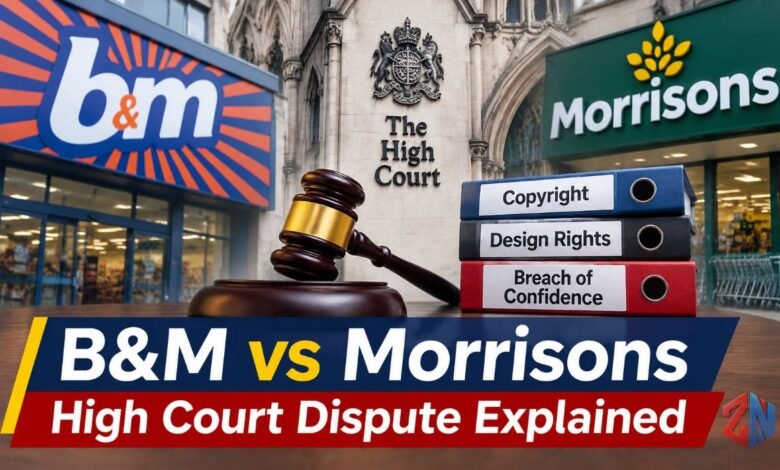
The search term “B&M Morrisons” has attracted attention following reports that B&M has started High Court proceedings against supermarket group Morrisons. Filed on 29 October 2026, the claim is listed as a copyright and design right case. B&M alleges intellectual property infringement and breach of confidence, but the products and information at issue have not been publicly identified. Here is what is known, what remains unclear and what shoppers should expect.
What Happened in the B&M Morrisons Court Case?
B&M Retail Limited has brought a claim against WM Morrison Supermarkets Limited and Simon Buckley. The public Folio case listing records the filing date as 29 October 2026 and classifies it under the High Court’s Intellectual Property List as a “copyright and design right” Part 7 claim. The listing, last updated on 30 October 2026, showed no published documents or docket entries.
The story became public in news reports on 2 November. B&M confirmed the proceedings and said it invests in product development and protects confidential business information. Morrisons declined to comment. B&M said it would not comment further while the matter is before the courts.
This is a live legal claim, not a judgment. No court has ruled that either defendant infringed B&M’s rights.
Why Is B&M Suing Morrisons?
B&M says the action concerns intellectual property infringement and breach of confidence. The court listing gives the case type as copyright and design right, but detailed allegations are not publicly available.
Neither retailer has identified the products, designs or confidential information involved, or the remedy B&M is seeking. It would be inaccurate to link the dispute to a particular household item, toy, seasonal product, package or supplier arrangement.
B&M says it invests significantly in product development and protecting confidential business information. That explains why these assets matter to the retailer, but it does not reveal what Morrisons is alleged to have done.
The B&M legal action against Morrisons is an allegation that must be tested through the legal process. The filing of a claim does not establish that the allegations are true.
What Do Copyright, Design Rights and Breach of Confidence Mean?
The three legal expressions are related, but they do not mean exactly the same thing. Understanding the difference helps explain why this case is being treated as an intellectual property dispute.
Copyright and Design Rights
Copyright generally protects original creative work, such as writing, artwork, software and music. It does not give a business ownership of a broad idea simply because it thought of it first. UK government guidance distinguishes copyright from design protection, which concerns the appearance of products.
Registered design protection can cover the appearance of a whole or part of a product, including its lines, contours, colours, shape, texture, materials and ornamentation, provided the legal requirements are met.
UK unregistered design rights generally protect the shape and configuration of three-dimensional objects, rather than surface decoration. Supplementary unregistered design protection can cover the two-dimensional or three-dimensional appearance of a whole or part of a product for three years from the date the design is made public.
A design dispute may involve what was created, when it was created, what protection applies and whether a protected design was used without permission. The case category does not reveal whether B&M relies on registered designs, unregistered design rights, copyright or a combination.
What Does Breach of Confidence Mean Under UK Law?
A breach of confidence claim is about the unauthorised use or disclosure of information that should have remained confidential.
In a business setting, that information might include product-development material, technical specifications, supplier information, pricing details, commercial plans or other sensitive records.
A commonly cited UK legal framework considers whether the information has the necessary quality of confidence, whether it was shared in circumstances creating an obligation of confidence, and whether it was used without authorisation. The traditional framework also considers detriment to the person who shared the information, although the precise role of detriment can depend on the circumstances.
This is why breach of confidence can be different from a straightforward argument that two products look alike. One issue concerns protected creative work or product design; the other concerns the handling of sensitive information. The public information does not explain how B&M says either occurred here.
Who Is Simon Buckley, and Why Is He Named in the Morrisons Case?
Simon Buckley is named alongside WM Morrison Supermarkets Limited in the public case listing. Morrisons’ supplier information lists Simon Buckley under its General Merchandise category, while news reporting describes him as a senior buyer for general merchandise.
Morrisons’ supplier information confirms his role, but neither it nor the public case listing explains the allegations against him. Public reports and the case record do not explain what he is alleged to have done or how he is connected to the disputed designs.
It is important not to treat being named in a civil claim as proof of wrongdoing. The allegations have not been established by a court, and the evidence and responses will need to be considered through the proceedings.
Why Does the B&M Intellectual Property Dispute Matter?
B&M and Morrisons have different core retail identities, but both operate beyond a narrow product category.
B&M describes its business model as sourcing fast-moving consumer goods and general merchandise. It also says its range includes its own branded general merchandise products.
Morrisons describes itself primarily as a food and grocery retailer, while its supplier information lists separate buying categories for general merchandise, clothing, household and pet products.
This context shows how a dispute over designs or confidential commercial information could arise between retailers with different core shopping missions. A value retailer and a supermarket can both sell selected non-food products.
Product ranges, design work and supplier relationships can all be commercially important. Distinctive products can help a retailer stand out, while confidential development information may support supplier negotiations or range planning.
However, this general industry context should not be mistaken for evidence about the case. No published source has confirmed that a particular product range, supplier, packaging design or buying decision is at the centre of the B&M claim.
Which Products Are Involved in the B&M Morrisons Court Case?
No specific products have been publicly identified in the reporting reviewed for this update. The case listing gives the legal category, but it does not include published claim documents or a description of the designs in dispute. B&M has also not named the products in its public statement.
Readers should be cautious about posts or headlines linking the dispute to a particular item without evidence. A product appearing in both retailers’ stores does not, by itself, prove copying or misuse of confidential information.
More reliable detail may become available if court documents are published, either party provides a fuller statement, or the court discusses the issues at a hearing. Until then, the responsible answer is that the products remain undisclosed.
Will the Case Affect Morrisons Customers or B&M Shoppers?
Public reporting does not say shoppers should stop buying or using a product, or that either retailer has announced a recall because of this case. No affected product has been identified.
An intellectual property claim does not automatically mean goods must be removed from shelves. Any restriction would depend on the relief sought and a court order or agreement between the parties. No such outcome has been reported.
For now, customers can treat this as a dispute between businesses rather than a consumer safety announcement.
If either retailer later identifies a product or announces a change to its range, customers should rely on the company’s official notices and the details of any court order rather than speculation.
What Happens Next in the Morrisons High Court Case?
The next developments are likely to be procedural. Morrisons may file a response, the parties may exchange further details and evidence, and the court may set directions. The dispute could be resolved by agreement or proceed to a hearing and judgment.
As of 3 November 2026, public reporting says a hearing has not yet taken place. The public case listing, last updated on 30 October 2026, showed no published docket entries or documents. That means the listing, at its latest recorded update, did not explain the detailed claim or provide a timetable for a hearing.
In commercial disputes of this kind, a court may be asked to prevent further use or disclosure of information, or to award compensation if the legal tests are met. Those are general possibilities, not confirmed requests in this case. The public listing does not say whether B&M is seeking an injunction, damages or another remedy, so reports should not present any one outcome as established.
Readers following the story should look for a formal Morrisons response, publication of claim details, identification of the products or designs, and any court order or hearing date. These developments will clarify the dispute better than speculation.
What Is the Key Takeaway from the B&M Morrisons Dispute?
B&M has filed a High Court claim against Morrisons and Simon Buckley, alleging intellectual property infringement and breach of confidence. The case is listed as a copyright and design right claim and was filed on 29 October 2026. Morrisons declined to comment when contacted by reporters.
The most important point is what remains unknown. The products, designs and confidential information at issue have not been publicly identified, and the allegations have not been tested in court.
The case may become clearer as documents are filed and proceedings develop, but for now it should be reported as an ongoing allegation—not a proven infringement or a confirmed product issue.
Also Read: TG Jones Store Closures UK: Full Update and Confirmed Closing Dates
Frequently Asked Questions
Why Is B&M Suing Morrisons?
B&M has initiated High Court proceedings alleging intellectual property infringement and breach of confidence. The case is classified as a copyright and design right dispute. The specific products and information involved have not been publicly disclosed.
Who Is Simon Buckley in the B&M Morrisons Case?
Simon Buckley is named as a defendant alongside Morrisons. The supermarket’s official supplier information identifies him as its senior buyer for general merchandise. The specific allegations concerning him have not been publicly explained.
Which Products Are Involved in the B&M and Morrisons Dispute?
Neither company has publicly identified the products or designs involved. The available case listing does not contain detailed claim documents.
Has Morrisons Responded to B&M’s Allegations?
Morrisons declined to comment when approached by journalists. B&M confirmed that it had commenced legal proceedings but said it could not comment further because the matter was before the courts.
Will Morrisons Remove Products from Its Shelves?
There is no publicly reported product removal or recall connected with this case. Any restrictions would depend on subsequent court orders or an agreement between the parties.
Has the High Court Made a Decision in the B&M Morrisons Case?
No judgment has been reported. As of 3 November 2026, the reporting confirms that a hearing has not yet taken place.