

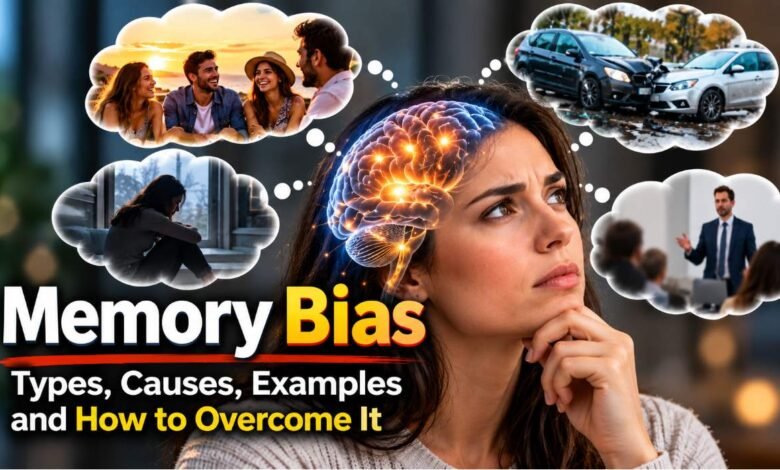
Memory bias is a psychological tendency that influences how people remember information, events, and personal experiences. It can make certain details easier to recall while causing others to become distorted, exaggerated, or forgotten. Even memories that feel completely accurate may not reflect exactly what happened.
Our brains do not store every experience like a video recording. Instead, remembering involves reconstructing information using past experiences, emotions, beliefs, and available details.
Understanding this process helps explain why two people can remember the same conversation differently, why past decisions sometimes seem better than they were, and why emotions influence personal memories.
This article explores the meaning of memory bias, its major types, psychological causes, everyday examples, and practical ways to reduce its influence.
What Is Memory Bias in Psychology?
In psychology, memory bias refers to systematic tendencies that influence what information people remember and how they recall it.
These tendencies can affect the accuracy, emotional meaning, or accessibility of memories. Sometimes they strengthen recall of particular information. In other situations, they contribute to incomplete or misleading recollections.
For example, someone who believes a colleague dislikes them may remember critical comments more easily than friendly interactions. Their expectations influence which experiences receive attention and remain accessible.
Memory distortions are not necessarily intentional. People may sincerely believe their recollections are accurate, even when important details have changed.
Psychologists study these processes to understand human learning, decision-making, emotional experiences, and eyewitness testimony.
How Does Memory Bias Work?
Human memory involves several interconnected processes. Bias can influence information at different stages, sometimes without conscious awareness.
Encoding: What Your Brain Notices
Encoding occurs when information is initially processed and represented in memory.
Attention strongly influences this stage. People naturally notice some details more than others, depending on their interests, expectations, and emotional state.
For example, someone feeling anxious during a presentation might focus on one disappointed facial expression while overlooking several encouraging reactions.
Storage: How Experiences Are Retained
After an experience, information may be retained in long-term memory.
Emotions, repeated thoughts, and later information can influence how memories are maintained. Details may become less accessible, while the overall meaning of an experience remains.
Importantly, memories are not necessarily preserved as complete, unchanging records.
Retrieval: How Memories Are Reconstructed
Retrieval happens when someone attempts to remember previously experienced information.
During this process, the brain draws on available details, knowledge, and associations to reconstruct an event.
Current beliefs and emotions may influence which details come to mind, creating differences between the original experience and its recollection.
Major Types of Memory Bias With Examples
Researchers have identified several forms of biased remembering. These patterns involve different psychological processes and do not affect everyone in the same way.
1. Selective Memory and Confirmation Bias
Confirmation bias describes the tendency to favor information that supports existing beliefs. It can also influence which experiences people notice and later remember.
Someone convinced that a particular restaurant provides poor service might remember one delayed order while forgetting several positive visits.
This selective recollection may strengthen their original opinion, even when the complete evidence tells a more balanced story.
2. Mood-Congruent Memory Bias
Mood-congruent memory occurs when a person’s emotional state favors recall of information with a similar emotional tone.
Someone feeling sad may find unpleasant experiences easier to remember. During a positive mood, enjoyable experiences may become more accessible.
Research supports this effect, although its strength depends on individual differences, experimental conditions, and the information being remembered.
Mood-related recall is not always predictable. People can also remember positive experiences while feeling unhappy.
3. Hindsight Bias
Hindsight bias is the tendency to view past outcomes as more predictable after learning what happened.
After a company fails, an investor might claim they always knew the business would struggle, despite previously expecting success.
Although hindsight bias is broadly a cognitive bias, knowledge of the final outcome can influence how people reconstruct their earlier beliefs.
This pattern may prevent accurate evaluation of decisions because uncertainty that existed beforehand becomes harder to appreciate.
4. The Misinformation Effect
The misinformation effect occurs when misleading information received after an event influences someone’s later recollection.
Psychologist Elizabeth Loftus and her colleagues demonstrated how questions and suggestions can affect memory reports.
For example, witnesses who hear inaccurate descriptions of a traffic accident may later include those details when describing what they observed.
A contemporary replication published in 2026 also found that misleading post-event information reduced accurate reporting of an original traffic sign.
This research is particularly relevant to eyewitness testimony and the spread of misleading information.
5. Choice-Supportive Memory Bias
Choice-supportive remembering involves recalling selected options more favorably than alternatives that were rejected.
Someone who purchases an expensive laptop might later exaggerate its advantages while minimizing the benefits of another model.
Research suggests that this pattern can involve incorrectly assigning positive features to the chosen option. Evidence for other forms of choice-related memory distortion is less consistent.
Such recollections may influence future purchasing decisions.
6. Consistency Bias
Consistency bias involves remembering past opinions, attitudes, or behaviors as being more similar to current ones than they actually were.
A person who recently adopted a healthier lifestyle might remember always being interested in exercise.
However, old conversations or written records may reveal that their previous priorities were quite different.
This tendency can make personal beliefs seem more stable over time.
7. Source Misattribution
Source misattribution happens when someone remembers information but incorrectly identifies where it came from.
For example, a person might recall an interesting fact from a social media post but mistakenly believe they learned it from a scientific article.
The information itself may be remembered correctly, while its origin is confused.
Source-monitoring errors matter because the credibility of information often depends on where it originated.
8. Fading Affect Bias
Fading affect bias describes a pattern in which negative feelings associated with past experiences often weaken faster than positive feelings.
For example, someone remembering an old holiday may still recall the travel problems, but the frustration associated with those difficulties may have faded more than the happiness linked to enjoyable moments.
This phenomenon may help explain why some people recall earlier periods of life with warmth despite difficulties.
However, painful memories do not always lose their emotional intensity.
Memory Bias vs. Cognitive Bias vs. False Memory
These related concepts overlap, but they are not identical.
| Concept | Meaning | Example |
|---|---|---|
| Memory bias | Systematic influence on remembering | Recalling criticism more easily than praise |
| Cognitive bias | Broader tendency affecting thinking or judgment | Favoring evidence that supports an existing belief |
| False memory | Recollection of something that did not happen as remembered | Remembering an event detail that was never present |
| Recall bias | Inaccurate reporting of past experiences, especially in research | Underestimating how frequently a behavior occurred |
The distinction matters because not every biased memory is completely false.
Sometimes a person accurately recalls an event but remembers only selected aspects. In other cases, the remembered details themselves are incorrect.
Everyday Examples of Memory Bias
Memory distortions are not limited to psychological experiments. They can influence familiar situations.
Relationships and Personal Conflicts
During an argument, two people may remember different statements or intentions.
Each person may focus on details that support their interpretation. Emotions and later conversations can further influence their recollections.
This does not automatically mean either person is deliberately lying.
Education and Learning
Students may remember questions they answered correctly more clearly than those they misunderstood.
After receiving examination results, they might also believe certain answers were obvious all along.
Reviewing original notes and practice answers provides a more accurate picture of their earlier understanding.
Work and Business Decisions
A manager might remember a successful project as having fewer risks than were actually discussed.
Similarly, unsuccessful decisions may appear clearly mistaken after the outcome becomes known.
Written meeting notes and documented forecasts can help separate original expectations from later interpretations.
Why Memory Bias Matters
Biased remembering can influence decisions, relationships, learning, and personal beliefs.
In workplaces, inaccurate recollections may create disagreements about responsibilities or earlier commitments.
In healthcare research, recall bias can affect studies that rely on participants accurately reporting previous experiences.
Eyewitness identification also requires careful procedures because suggestions and misleading information can influence recollections.
Importantly, confidence does not always guarantee accuracy. Research on vivid memories of major public events has found that people can remain confident even as the consistency of their recollections declines.
Recognizing this limitation encourages more careful judgments without assuming that every memory is unreliable.
How to Reduce Memory Bias
People cannot completely eliminate memory bias, but several practical habits can improve the way they evaluate recollections.
- Record important information promptly. Write down decisions, observations, and conversations while details are relatively fresh. Include dates and distinguish facts from personal interpretations.
- Check independent evidence. Compare recollections with documents, photographs, messages, or other reliable records when accuracy matters.
- Consider alternative explanations. Ask whether the same experience could reasonably be interpreted differently. This helps prevent existing beliefs from controlling the entire story.
- Avoid leading questions. When discussing a remembered event, use neutral questions rather than suggestions that introduce unverified details.
- Separate confidence from accuracy. Feeling certain about a memory is not sufficient proof that every detail is correct.
- Revisit your original decisions. Keep a record of expectations, reasons, and uncertainties before important outcomes become known.
These methods do not guarantee perfect recall. Their main benefit is reducing unnecessary assumptions and providing independent information against which memories can be checked.
Can Memory Bias Ever Be Helpful?
Not every feature associated with biased memory is harmful.
Human memory prioritizes meaningful information rather than preserving every detail equally. This supports efficient learning, recognition, and everyday decision-making.
Some emotional memory patterns may also help people maintain positive perspectives on previous experiences.
However, an efficient memory system is not necessarily an accurate historical record.
The goal is not to remember everything perfectly. It is to recognize when personal recollections need verification, especially when important decisions depend on them.
Conclusion
Memory bias reveals an important feature of human psychology: remembering is an active process rather than a perfect replay of past events.
Beliefs, emotions, expectations, and information received afterward can influence how experiences are recalled.
Understanding these patterns makes it easier to recognize inaccurate assumptions, evaluate disagreements, and make informed decisions.
By combining self-awareness with reliable records and thoughtful questioning, people can reduce avoidable memory errors while appreciating the strengths and limitations of human recollection.
Also Read: What Is the One In, One Out Policy? Meaning, Rules, and Decluttering Guide
Frequently Asked Questions
What is memory bias in simple words?
Memory bias is the tendency to remember certain information differently from how it originally occurred. It can cause people to emphasize particular details, overlook others, or recall events inaccurately because of emotions, expectations, or later information.
What is an example of memory bias?
A person who believes their manager is unfair may easily remember negative feedback while overlooking previous praise. Their existing opinion influences which experiences are most accessible in memory.
What causes memory bias?
Memory bias can arise from selective attention, emotional states, existing beliefs, suggestive information, and the reconstructive nature of remembering. Different types of memory distortion involve different psychological mechanisms.
What is the difference between memory bias and confirmation bias?
Memory bias concerns systematic patterns in how information is remembered. Confirmation bias is a broader tendency to favor evidence supporting existing beliefs. Confirmation bias can contribute to selective remembering, but the concepts are not interchangeable.
Can memory bias be completely eliminated?
No. Memory is naturally selective and reconstructive. However, documenting important events, checking independent evidence, considering alternative viewpoints, and avoiding suggestive questions can help reduce errors.
Does memory bias mean someone is lying?
No. People can remember an event inaccurately while genuinely believing their recollection. Lying involves intentional deception, whereas memory errors can occur without deliberate dishonesty.