
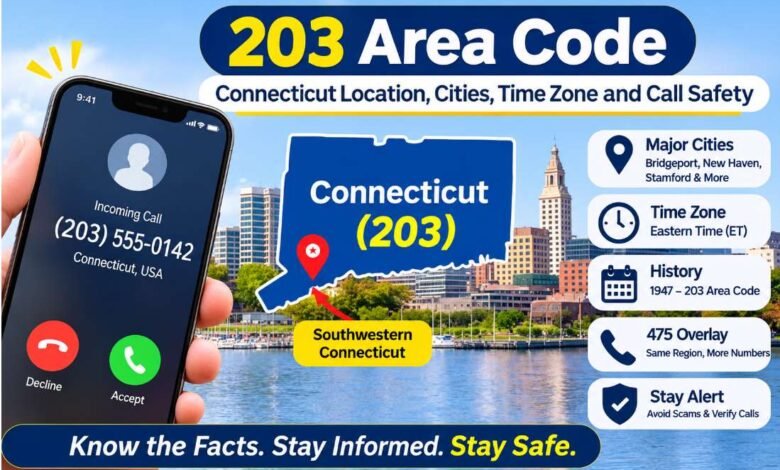
The 203 area code belongs to southwestern Connecticut in the United States. It covers cities including Bridgeport, New Haven, Stamford, Norwalk, Danbury and Waterbury. If a number begins with 203, it was generally assigned within this part of Connecticut, although that does not prove where the caller is today.
Here is where 203 operates, how it relates to 475, which time zone to use and what to check before returning an unexpected call.
203 Area Code at a Glance
| Detail | Information |
|---|---|
| State | Connecticut, United States |
| Main service region | Southwestern Connecticut |
| Major cities | Bridgeport, New Haven, Stamford, Norwalk, Danbury and Waterbury |
| Time zone | Eastern Time (ET) |
| UTC offset | UTC−5 in standard time; UTC−4 during daylight saving time |
| Introduced | 1947 |
| Overlay area code | 475 |
| Local dialing | 10 digits, including the area code |
| Country calling code | +1 |
Where Is the 203 Area Code Located?
Area code 203 covers most of Fairfield County, excluding Sherman, all of New Haven County, and a small part of Litchfield County, including Bethlehem, Woodbury and part of Roxbury. It is not an area code for New York City, even though parts of its territory are close to the metropolitan area.
Major Cities and Towns Using 203
The best-known communities include:
- Bridgeport: A major city on Connecticut’s coast.
- New Haven: Home to Yale University and a regional center for education and healthcare.
- Stamford: A business center near the New York border.
- Norwalk and Greenwich: Communities along the southwestern coast.
- Danbury and Waterbury: Important inland cities.
- Milford, Fairfield, Stratford and West Haven: Other communities within the same numbering region.
An area code identifies a broader telephone-numbering territory, not a single ZIP code or neighborhood. Even numbers associated with the same city may have different area codes because of the overlay system.
History of the 203 Area Code
Connecticut received 203 in 1947, when the original North American area-code system was introduced. At first, one code served the entire state. Growing demand from households and businesses eventually made more numbering capacity necessary.
In 1995, area code 860 was created by splitting away much of Connecticut from the original 203 region. The older code remained in the southwestern part of the state.
A second major change came on December 12, 2009, when 475 entered service as an overlay for 203. Instead of redrawing the map again, regulators allowed both codes to serve the same territory. Existing 203 numbers could remain unchanged while additional numbers became available through 475. Mandatory 10-digit dialing had already begun across Connecticut on November 14, 2009, requiring residents to include the area code even when calling nearby numbers.
What Is the Difference Between 203 and 475?
The 475 area code is an overlay of 203. That means both serve the same general geographic region. Someone in Stamford might have a 203 number, while a neighbor or nearby business has a 475 number.
An overlay is different from a geographic split. A split gives separate places different area codes; an overlay adds another code to an existing region.
Because both codes operate together, 10-digit dialing is required for local calls. That means including 203 or 475 before the seven-digit number. Also, a call between two numbers in this region is not necessarily free: billing depends on the provider and calling plan, not just the area codes.
What Time Zone Does Area Code 203 Use?
The region follows Eastern Time (ET), the same time zone used in New York City. During Eastern Standard Time, its offset is UTC−5. During daylight saving time, it changes to Eastern Daylight Time, or UTC−4.
For example, when it is 3:00 p.m. in London during a period when London is five hours ahead of Connecticut, it is 10:00 a.m. in the 203 region. The UK and US change their clocks on different dates, so the time difference can briefly vary in spring and autumn.
If you are calling a Connecticut business from another country, check its current local time and published opening hours.
How to Dial a 203 Phone Number
A standard US number has a three-digit area code followed by a seven-digit local number. A fictional example is (203) 555-0142. This example number is reserved for fictional use and is provided only to demonstrate the dialing format. The seven-digit portion distinguishes one number from another within the numbering region.
Dialing Within the United States
For a local call, enter all 10 digits: 203-555-0142. If you are calling from a landline and the call is classified as long-distance, your provider may require a leading 1: 1-203-555-0142. Mobile devices can usually use the complete 10-digit format.
Calling From Another Country
Use the US country calling code, +1, followed by the full number: +1 203 555 0142. On a mobile phone, the plus sign normally substitutes for the international access prefix. International call charges depend on your operator and plan.
Remember that 203 is not a toll-free prefix. It is a geographic code, so calling costs depend on the plan and the nature of the call.
Who Is Calling Me From a 203 Number?
A number beginning with 203 might belong to a resident, school, healthcare provider, retailer or other organization. However, its area code alone cannot establish who owns it or whether the call is genuine.
People can keep mobile numbers after moving away, businesses can route calls using internet-based phone services, and scammers can falsify the number shown on your screen. As a result, a 203 caller may be outside Connecticut or may not control the number displayed.
If you want to investigate an unfamiliar number, search the complete 10-digit number, not only the area code. Look for an official business listing, a message you were expecting or a voicemail with enough context to verify independently. Reverse-number lookup services can provide clues, but their owner and location information may be incomplete or outdated.
Are 203 Area Code Calls Scams?
No. The 203 area code is a legitimate geographic telephone code. Receiving a call from this area code does not automatically mean the call is fraudulent. But an unfamiliar call displaying 203 should not be treated as trustworthy merely because the number looks local.
The Federal Trade Commission warns that criminals can manipulate caller ID through spoofing. One method, sometimes called neighbor spoofing, makes an incoming number resemble the recipient’s own area code or prefix. A scammer may claim to represent a bank, delivery company, government agency or technical-support provider.
Red Flags to Watch For
Be cautious if a caller pressures you to act immediately, requests a password or one-time verification code, demands payment through gift cards or cryptocurrency, or threatens arrest unless you pay. An unexpected automated message that tells you to press a button can also be suspicious.
If anything feels wrong, end the call. Contact the organization using a telephone number from its official website, account statement or another trusted record. Do not rely on the callback number the caller provides.
You can enable spam filtering through your phone or carrier, block repeated unwanted calls, and report suspected fraud to the Federal Trade Commission. For unwanted sales calls without financial loss, the National Do Not Call Registry’s reporting service is another option.
Can You Get a New 203 Area Code Number?
You may be able to request a 203 number from a participating mobile, landline or business phone provider, depending on its available inventory and eligibility rules. Because 475 covers the same area, a provider may offer that code instead. Having a Connecticut-area number does not necessarily mean a company operates from a physical office there; virtual phone services can route calls elsewhere.
Before choosing a provider, check number availability, monthly charges, calling features and whether you can transfer the number if you switch services. Existing numbers can often be retained when changing providers through a process called number porting, subject to applicable rules and technical limitations.
Other Connecticut Area Codes to Know
Connecticut has four active area codes organized into two overlay regions:
| Area codes | General coverage |
|---|---|
| 203 and 475 | Southwestern Connecticut, including Bridgeport, New Haven and Stamford |
| 860 and 959 | Much of the rest of Connecticut, including the Hartford area |
Conclusion
The 203 area code identifies a long-established telephone region in southwestern Connecticut. It serves major cities such as Bridgeport, New Haven and Stamford, follows Eastern Time and shares its coverage with 475. Local calls require the full 10-digit number. If an unexpected call appears to come from 203, remember that caller ID can be spoofed and verify the caller before sharing information.
Also Read: Nvidia Chip Guide: AI Power, Latest Models and China Rules
Frequently Asked Questions
What state is the 203 area code in?
It is in Connecticut, primarily serving the southwestern part of the state. The region includes Bridgeport, New Haven, Stamford, Norwalk, Danbury and Waterbury.
Is 203 a cell phone or landline area code?
It can be used for both, as well as certain business and internet-based telephone services. The area code alone cannot tell you what type of connection a specific person uses.
Is the 203 area code the same as 475?
They are different area codes covering the same geographic territory. The 475 overlay was introduced in 2009 to provide additional telephone numbers without replacing existing 203 numbers.
Do I need to dial 1 before a 203 number?
For local calls in Connecticut, dial the full 10-digit number. A leading 1 may be necessary for some long-distance landline calls. From outside the United States, use +1 followed by the 10-digit number.
Should I answer an unknown 203 call?
You do not need to answer an unexpected call. Letting it go to voicemail is reasonable. If it claims to be from an important organization, independently confirm the number before returning the call or sharing information.