
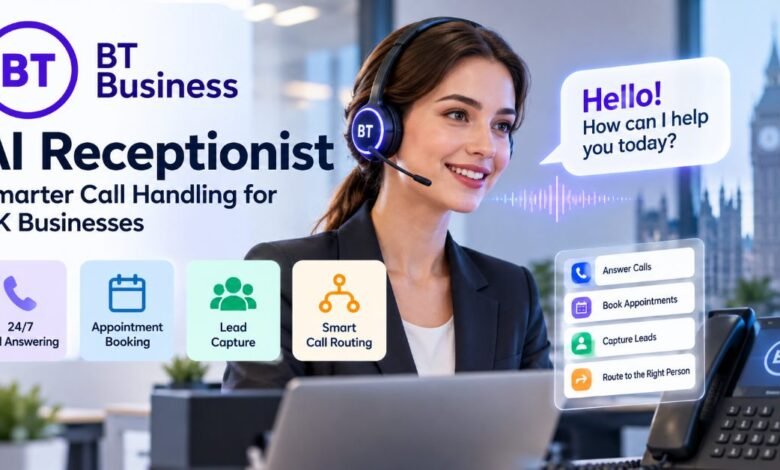
BT AI Receptionist is designed to answer business calls when employees are busy, unavailable or outside normal working hours. It can deal with common questions, capture customer information, arrange appointments and transfer callers to the right person.
The service has become a more visible part of BT Business’s AI strategy following the launch of its AI from BT portfolio on 1 October 2026. BT is positioning the technology particularly toward businesses where an unanswered phone call can mean a lost booking, lead or sale.
But an AI receptionist is more than an advanced voicemail system. Understanding what it can do, where human staff are still needed and how BT charges for the service is important before deciding whether it makes sense for a business.
What Is BT AI Receptionist?
BT AI Receptionist is an AI-powered virtual phone assistant for businesses. Instead of simply recording a voicemail, it can communicate with callers in real time and respond according to information supplied by the business.
BT says the service can operate 24 hours a day, answer common questions, capture leads, arrange bookings and transfer callers to relevant people or departments. Multiple calls can also be handled at the same time.
Businesses can provide information through sources such as their website, FAQs and uploaded documents. This gives the receptionist a knowledge base it can use when answering routine customer questions.
For example, a restaurant could teach it opening hours, booking information and accessibility details. An estate agent could use it to collect information from prospective buyers and arrange viewings.
The objective is not necessarily to remove people from customer service. A more practical use is allowing AI to handle predictable requests while employees concentrate on calls or situations that require human judgement.
BT AI Receptionist vs AI Receptionist Everywhere
One important detail is that BT currently refers to two related services.
AI Receptionist (AIR) is available to customers using BT Cloud Work.
AI Receptionist Everywhere (AIRE) is a standalone service and does not require a business to purchase BT Cloud Work first. Both services can answer calls, respond to common questions and route callers.
This distinction matters for businesses that already have another phone provider or communications system.
BT says its newer AI Receptionist offering can work across UK fixed and mobile networks. Businesses can keep their existing phone number rather than replacing their whole telephone setup just to introduce an AI answering service.
That potentially makes the technology relevant to smaller businesses that want to experiment with AI without carrying out a larger communications-system migration.
How Does BT AI Receptionist Work?
The basic process starts with giving the AI accurate information about the business.
A company can train or configure the receptionist using its existing website, FAQs, documents and other approved business information. The system then uses this knowledge to respond to customer enquiries.
A typical call might work like this:
- A customer calls the business.
- The AI Receptionist answers using a customised greeting.
- It identifies what the caller needs.
- It answers an approved common question, captures information, arranges an appointment or routes the call.
- More complicated enquiries can be transferred to a person or team.
The BT Cloud Work portal is used to manage AIR and AIRE settings. BT’s support documentation also includes options for calendars, analytics, transcripts, customised skills and multilingual functionality.
This gives businesses more control than a basic automated phone menu where callers have to press numbers to reach different departments.
Key BT AI Receptionist Features
24/7 Call Answering
The service can answer calls around the clock or be configured around business hours.
That could be particularly useful for a tradesperson working on-site, a restaurant during a busy service period or a small office where nobody is permanently available to answer the phone.
Appointment and Booking Management
BT says AI Receptionist can schedule appointments and integrate with Google Calendar and Outlook. Confirmation and booking functions can reduce the amount of routine administrative work handled manually.
Lead Capture
A potential customer does not necessarily have to reach an employee immediately.
The AI can collect relevant details so the business has information available for follow-up. BT’s material also describes lead capture as part of its AI Receptionist capabilities.
Intelligent Call Routing
The system can send callers to the appropriate employee or department when human involvement is required.
That can be useful for organisations with different sales, support or service teams because the caller can explain what they need rather than navigating a long telephone menu.
Custom Business Knowledge
Businesses can provide information that determines how routine questions are answered.
This is one of the most important parts of implementation. An AI receptionist supplied with incomplete opening hours, outdated prices or old policies could confidently give customers information that is no longer correct.
Businesses therefore need to treat the knowledge base as something that requires regular maintenance.
Call Information and Analytics
BT provides support for analytics and, depending on the service configuration, call transcripts and recording-related features.
These tools can help a business understand why customers are calling and identify questions that appear repeatedly.
Why Has BT Introduced an AI Receptionist?
Missed calls are a significant part of BT’s marketing case for the product.
Research commissioned by BT Business in September 2026 surveyed 1,500 UK SME decision-makers and 2,000 UK adults. BT reported that 67% of SMEs surveyed said they miss at least one call on an average day that they believe results in lost business. Its economic modelling estimated about £3.7 billion in annual revenue could be lost by UK small businesses through missed calls.
That £3.7 billion figure should be understood as an estimate rather than a measured total. BT explains that the calculation uses businesses’ reported losses, survey responses and wider business-population data.
The broader problem is straightforward: a small company may have customers calling precisely when its employees are least able to answer.
A plumber might be working inside a customer’s property. Restaurant employees may be serving diners. An estate agent could be conducting a viewing. In each case, an unanswered call could represent a genuine sales opportunity.
Which Businesses Could Benefit Most?
The strongest use case is generally a business that receives frequent, repetitive and commercially important calls.
BT specifically highlights trades and field-based businesses, estate agents, healthcare and professional practices, legal and financial services, retailers, restaurants, pubs and hospitality businesses.
Consider a small plumbing company. Many calls may involve the same basic questions: service area, availability, emergency work and appointment times.
Having the AI collect those details could be valuable.
By contrast, a specialist consultancy receiving only a few highly technical calls each week may gain less from automating the first conversation.
The question is therefore not simply whether AI sounds useful. Businesses should consider how many calls they miss, why customers call and how much of that conversation can safely follow a repeatable process.
How Much Does BT AI Receptionist Cost?
BT’s public AI Receptionist page does not currently show one simple headline monthly price.
Instead, the service is billed using inbound call minutes. BT states that bundles are available from 100 to 14,000 minutes per month, with additional minute and overage options. The contract is described as monthly rolling.
As of 5 October 2026, BT is also advertising 50% off its 100- and 300-minute packages for six months, with the promotion listed as running from 2 October to 20 November. The underlying standard package prices are not displayed on the public product page, so businesses should obtain a current quote rather than relying on unofficial pricing published elsewhere.
BT also lists an optional one-hour professional-services education session at £150 one-off.
Usage is important because the service is minute-based. BT says administrators receive alerts at 80% and 100% of their allowance. Overage is disabled by default but can be enabled with a spending cap.
Is BT AI Receptionist Secure?
Any AI system handling customer conversations deserves careful attention to privacy.
BT states that customer data used by the AI Receptionist remains private and is not used to train AI models. BT also publishes contractual and data-processing documentation for AI Receptionist Everywhere.
However, buying an AI service does not remove a business’s own responsibilities.
Companies should decide what information the receptionist is allowed to collect, who can access transcripts or recordings, how long data needs to be retained and when sensitive conversations should be passed to a person.
This becomes especially important in areas such as healthcare, financial services and legal work.
BT AI Receptionist Advantages and Limitations
The main advantage is availability. The technology does not need to leave a job site, finish serving another customer or return to the office before answering a routine call.
It can also reduce repetitive administrative work and create a more consistent first response.
However, AI should not automatically handle every conversation.
Complaints, emergencies, unusual circumstances, vulnerable customers and enquiries requiring professional judgement may need rapid escalation to a human.
Businesses should therefore design the service around clear boundaries rather than trying to automate everything.
Is BT AI Receptionist Worth It?
BT AI Receptionist could be useful for UK businesses where missed calls regularly mean missed appointments, leads or sales.
The strongest case is likely to be a small or medium-sized organisation receiving enough predictable telephone enquiries to justify automation but not wanting an employee permanently dedicated to answering routine calls.
Before subscribing, a business should estimate its monthly incoming call minutes, identify its most common questions and decide which situations must always reach a person.
The real value will not come simply from having an AI answer the phone. It will come from configuring that AI with accurate information, sensible escalation rules and a clear role alongside human employees.
For businesses that get those elements right, an AI receptionist could turn the telephone from a constant interruption into a more manageable customer-service channel.
Also Read: OpenAI Dots: What They Are, How They Work, Features, Availability and Safety
FAQ
What is BT AI Receptionist?
BT AI Receptionist is an AI-powered virtual assistant that can answer business phone calls, respond to common questions, capture customer information, manage bookings and transfer callers to relevant employees or departments.
Can BT AI Receptionist answer calls 24/7?
Yes. BT states that AI Receptionist can operate 24/7, although businesses can also configure it around their normal working hours.
Do I need BT Cloud Work to use BT AI Receptionist?
Not necessarily. AI Receptionist, or AIR, is designed for BT Cloud Work customers. AI Receptionist Everywhere, or AIRE, is a standalone service that does not require BT Cloud Work.
Can BT AI Receptionist book appointments?
Yes. It can manage appointments and BT says the service can integrate with Google Calendar and Outlook for scheduling.
How much does BT AI Receptionist cost?
BT currently sells the service in inbound-minute bundles ranging from 100 to 14,000 minutes per month, but its public product page does not list a single standard monthly price. Businesses should request a current quote based on expected usage.
Can BT AI Receptionist replace a human receptionist?
It can automate many routine tasks, but it is better viewed as support rather than a complete replacement in every situation. Complex complaints, sensitive conversations, emergencies and enquiries requiring professional judgement may still need a human employee.