
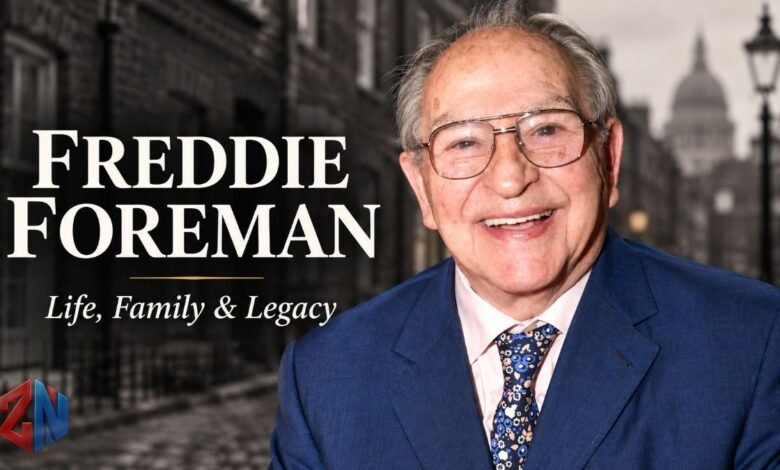
Freddie Foreman was an English gangster, convicted criminal and author best known for his association with the Kray twins. News reports published on 10 October 2026 announced that he had died aged 94, bringing renewed attention to a life that later became the subject of books and a documentary.
Known as “Brown Bread Fred”, he occupied a prominent place in accounts of London’s criminal underworld. But his reputation needs careful explanation: offences that resulted in prison sentences, murders he later admitted, and stories surrounding his name are not interchangeable.
His biography also reaches beyond the Krays. It includes his Battersea upbringing, marriage to Maureen, actor son Jamie Foreman and efforts to tell his own version of events.
Quick Bio
| Detail | Information |
|---|---|
| Full name | Frederick Gerald Foreman |
| Known as | Freddie Foreman, Brown Bread Fred |
| Born | 5 March 1932 |
| Birthplace | Battersea, London, England |
| Death reported | 10 October 2026 |
| Age at death | 94 |
| Nationality | British |
| Occupations | Publican and author |
| Wife | Maureen Foreman |
| Children | Gregory, Jamie and Danielle |
| Known for | London criminal history and association with the Kray twins |
| Notable book | Respect |
| Documentary | Fred, directed by Paul Van Carter |
Freddie Foreman’s Death: What Has Been Reported?
British news outlets reported that Foreman died on 10 October 2026. Reporting published by the Express and carried by AOL said he died in a west London care home after a short illness, with his eldest son Greg present.
The reports described a short illness but did not identify a specific medical cause.
For readers asking whether Freddie Foreman is still alive, the latest reporting answers that question: his death was announced at the age of 94. Older biographies describing him as a living figure predate this development.
Early Life in Battersea
Freddie Foreman was born in Battersea, south London, on 5 March 1932. His full name was Frederick Gerald Foreman.
That birthplace is worth distinguishing from his later East End associations. Although he is regularly described alongside East London gangsters, his own origins were south of the River Thames.
He was a child during the Second World War. The documentary Fred places his early years against that wartime background and follows the contrast between his childhood surroundings and his later notoriety.
Foreman also worked as a publican. At the time of the arrests that preceded the Kray trials, he was the licensee of the Prince of Wales pub in Southwark.
Why Was He Called Brown Bread Fred?
“Brown bread” is Cockney rhyming slang for “dead”. Foreman’s nickname referred to his reputation for dealing with bodies and his association with gangland killings.
It became an enduring part of his public identity and appeared in the title of his autobiography Brown Bread Fred.
Freddie Foreman and the Kray Twins
Ronnie and Reggie Kray were central to Foreman’s notoriety. He was an associate of the twins and became linked to some of the most extensively discussed events surrounding their criminal circle.
Their relationship is often summarised by describing him as an enforcer. That captures part of his reputation, but it does not explain the separate events that connected him to them.
The clearest way to understand the association is through individual cases: his role in disposing of Jack “the Hat” McVitie’s body, and his later admission concerning Frank Mitchell.
Jack “the Hat” McVitie
Reggie Kray killed McVitie in 1967. Foreman was convicted over his role in helping dispose of the body and received a ten-year prison sentence.
The distinction is straightforward but significant: involvement in concealing a body is different from being convicted as the person who carried out the killing.
Frank Mitchell and Tommy “Ginger” Marks
Foreman later admitted involvement in the killings of Frank Mitchell and Tommy “Ginger” Marks, despite having previously been acquitted of their murders.
Mitchell had escaped from Dartmoor in December 1966 with help from the Krays’ associates. He subsequently disappeared, and his body was never recovered. Foreman’s account of killing him appeared in his memoir Respect.
The Marks case was separate. Marks was killed in 1965, and Foreman later acknowledged responsibility.
These were admissions made after acquittals, not murder convictions.
The Security Express Robbery and Prison Sentence
Another major chapter involved the 1983 Security Express robbery in Shoreditch, east London. Raiders stole around £6 million from the cash-handling depot.
The attack involved serious intimidation. A 2014 retrospective report by IBTimes UK describes a security guard being doused with petrol and threatened during the raid. That detail challenges any suggestion that a large cash robbery was simply a clever financial operation without human victims.
Foreman later received a nine-year sentence for handling proceeds from the robbery. He was not convicted of carrying out the raid itself.
Reports of his later life place his release from prison in 1995.
His Wife, Children and Actor Son Jamie Foreman
Freddie Foreman was married to Maureen, and they had three children: Gregory, Jamie and Danielle.
Jamie became the most publicly recognisable member of the family outside true-crime circles. His acting credits include Duke in Layer Cake, Bill Sikes in Roman Polanski’s Oliver Twist and Derek Branning in EastEnders.
This connection explains why readers sometimes encounter Freddie’s name while looking into British television or film. Jamie’s professional biography and his father’s criminal history are separate stories, even though coverage frequently brings them together.
Reporting around the 2018 documentary described distance between Foreman and his sons. The Express report carried by AOL in October 2026 said Greg was present when he died.
The available accounts describe particular moments, rather than a complete picture of private family life.
Freddie Foreman’s Books
His best-known titles include:
- Respect, first published by Century in 1996.
- Brown Bread Fred, published by John Blake in 2007.
- The Last Real Gangster.
- The Godfather of British Crime.
There is a small but useful distinction around Respect’s publication date. The original Century edition appeared in 1996, while an Arrow edition followed in 1997. References to either year may therefore describe different editions.
Memoirs can provide valuable first-person material, including admissions and recollections unavailable elsewhere. They also give their subjects control over emphasis, explanation and self-presentation.
For that reason, Foreman’s books are best understood as his account of events. A claim appearing in an autobiography does not automatically carry the same evidential weight as a documented court finding.
The Fred Documentary
The 2018 documentary Fred was written and directed by Paul Van Carter. The British Council’s UK Films Database lists an 85-minute running time and its world premiere at CPH:DOX.
Built around an extended interview, the film examines an older Foreman looking back on his life. Its focus includes memory, responsibility and the relationship between the man and his public reputation.
Local coverage of its East End screening also described archive footage, interviews and a return to Battersea. Those elements place his recollections within a wider personal and geographical setting.
The film is a documentary about Foreman, rather than a fictional drama with an actor playing him. It offers access to his personality and storytelling, while leaving viewers with the task of assessing how he presents his actions.
Understanding His Legacy
Foreman’s life sits at the intersection of criminal history and true-crime entertainment. His convictions belong to the historical record; his memoirs and screen appearances helped shape how later audiences encountered that record.
A balanced account can acknowledge why he attracted public interest without treating notoriety as an achievement. The people harmed by violence, intimidation and prolonged family separation also belong in the story.
Also Read: Ray Winstone: Age, Wife, Daughters, Best Movies and 2026 Career
FAQ
Who was Freddie Foreman?
Freddie Foreman was an English gangster, publican and author associated with the Kray twins. He received prison sentences connected to disposing of McVitie’s body and handling Security Express robbery proceeds.
When did Freddie Foreman die?
News reports announced his death on 10 October 2026, aged 94. Reporting described a short illness but did not specify a medical cause.
Who was Freddie Foreman’s wife?
His wife was Maureen Foreman. They had three children: Gregory, Jamie and Danielle.
Is Jamie Foreman Freddie Foreman’s son?
Yes. Jamie is his son and an actor known for EastEnders, Layer Cake and Oliver Twist.
Was Freddie Foreman convicted of murder?
He was acquitted of the murders of Frank Mitchell and Tommy Marks, which he later admitted. Those admissions should not be described as murder convictions.
Which documentary tells his story?
Fred, released in 2018, is an 85-minute documentary written and directed by Paul Van Carter.